
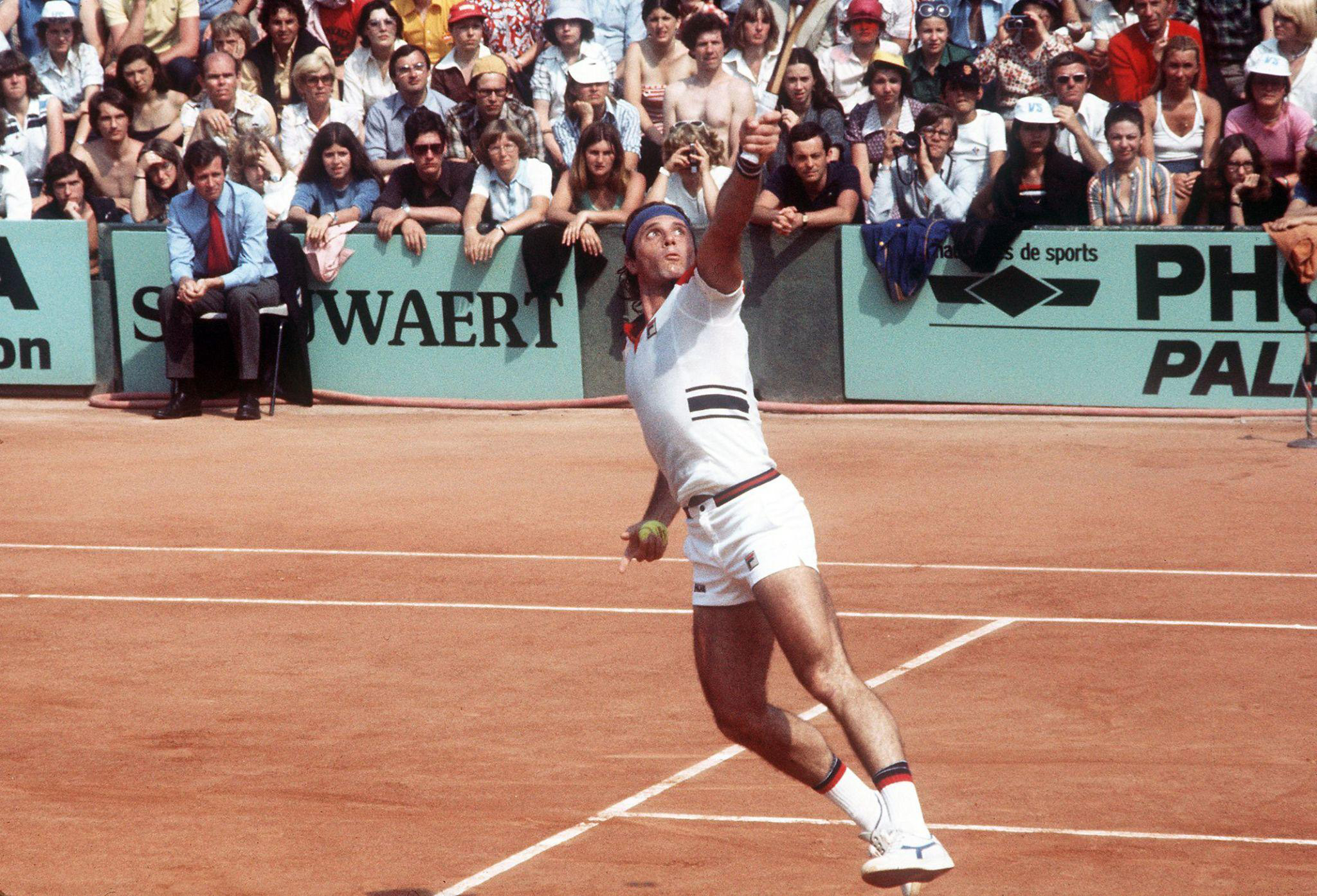
Seven consecutive tournament championships. Forty-six matches without defeat. Two Grand Slam titles in one extraordinary season. The Argentine tennis legend who conquered the courts of the world—yet never officially became World No. 1.
In the summer of 1977, something extraordinary began happening in professional tennis.
An Argentine player with flowing hair, a distinctive headband, a powerful left arm, and seemingly inexhaustible stamina started winning.
And he kept winning.
Tournament after tournament. City after city. Opponent after opponent.
From the mountains of Austria to the tennis clubs of America, from Forest Hills in New York to the courts of Paris, Guillermo Vilas won 46 consecutive singles matches and captured seven consecutive tournament championships.
It was a winning streak unlike anything officially recorded in men’s Open Era tennis.
Yet the most extraordinary part of this story is that Vilas accomplished his greatest feats during a season in which the official rankings never placed him at World No. 1.
Nearly half a century later, his accomplishments remain among the most remarkable examples of competitive endurance in sporting history.
This is the story of Guillermo Vilas, the man whose winning streak became bigger than the ranking system itself.
The Making of an Argentine Champion
Guillermo Vilas was born on August 17, 1952, in Buenos Aires, Argentina, and grew up in the coastal city of Mar del Plata.
He developed his tennis skills on the clay courts that would eventually become his natural competitive environment.
Unlike players whose games relied primarily on overwhelming serves or quick points at the net, Vilas built his success on patience, physical strength, and relentless consistency.
His powerful topspin groundstrokes pushed opponents deep behind the baseline. His conditioning allowed him to survive exhausting rallies. His determination made every point a contest of endurance.
He became known as the Young Bull of the Pampas.
But there was another side to his personality.
Vilas was also a poet, musician, and avid reader. He approached competition with unusual philosophical curiosity, combining a fierce appetite for victory with an interest in artistic expression.
By the middle of the 1970s, he had established himself among the world’s leading tennis players.
In 1974, he won the prestigious season-ending Masters championship.
In 1975, he reached the French Open final, losing to Sweden’s Björn Borg.
The foundation had been established.
What followed in 1977 would become the defining achievement of his career.
The First Triumph: Roland-Garros, June 1977
The year began with frustration.
Vilas reached the Australian Open final in January 1977 but lost to American Roscoe Tanner in straight sets.
It was another major final without a major championship.
But instead of accepting the disappointment, Vilas continued refining his game under the guidance of Romanian coach Ion Țiriac.
The relationship improved his tactical awareness, serving, and willingness to attack the net.
When the French Open began in May, Vilas was prepared.
He moved through the tournament with extraordinary efficiency.
On June 5, 1977, he faced American Brian Gottfried in the championship match at Roland-Garros.
Vilas delivered a performance of astonishing dominance.
Final score: 6–0, 6–3, 6–0.
He surrendered just three games in the entire final.
At age 24, Guillermo Vilas became the first Argentine man to win the French Open singles championship.
The victory represented more than a personal breakthrough.
For Argentina, it was a landmark in international sporting history.
For Vilas, it confirmed that years of preparation had finally produced a Grand Slam champion.
Yet his most remarkable sequence of victories had not even begun.
The Winning Streak Begins: July 1977
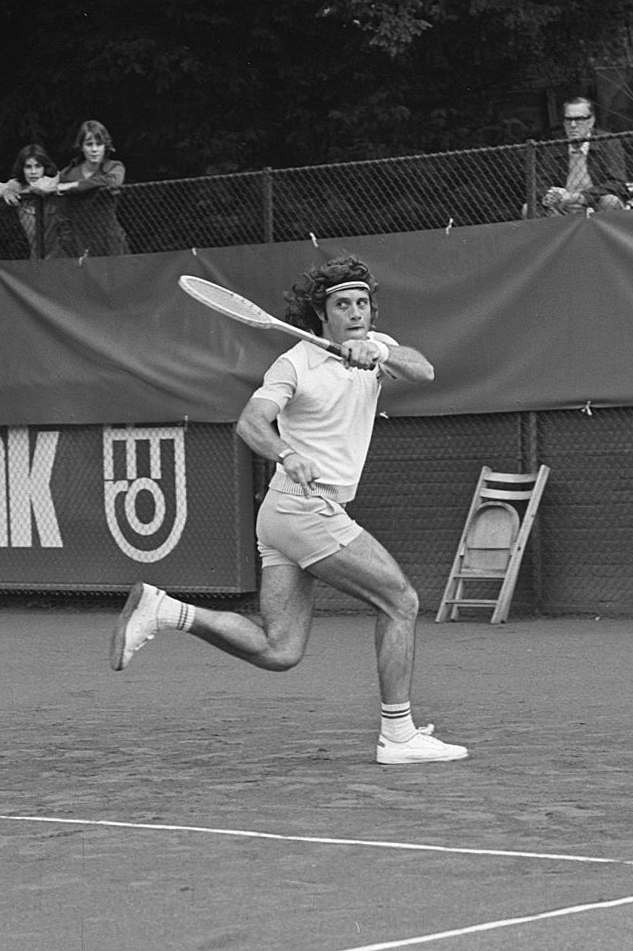
After competing at Wimbledon, Vilas returned to the surfaces and playing conditions that best suited his extraordinary endurance.
In July, he travelled to Kitzbühel, Austria.
There, he captured another tournament championship.
Then came Washington.
Another championship.
Louisville.
Another championship.
South Orange.
Another championship.
Columbus.
Another championship.
Each tournament brought fresh opponents, changing playing conditions, demanding travel schedules, and mounting expectations.
Yet the results remained astonishingly consistent.
Vilas was winning so frequently that the normal rhythm of professional tennis seemed to disappear.
There were no early exits to recover from, no defeats to reconsider, no pauses in his competitive momentum.
Every tournament ended with the Argentine holding another trophy.
By September, his winning streak had become one of the major stories in international sports.
And the US Open was approaching.
Forest Hills: The Victory That Made History
On September 11, 1977, Guillermo Vilas walked onto the center court of the West Side Tennis Club in Forest Hills, New York.
Across the net stood Jimmy Connors, the defending US Open champion and the world’s top-ranked player.
The championship was played on Har-Tru green clay, a surface that rewarded patience, physical conditioning, and tactical consistency.
It was also the final men’s US Open championship match to be played at Forest Hills before the tournament moved to Flushing Meadows.
Connors began aggressively.
He won the opening set 6–2.
But Vilas adjusted.
Rather than relying exclusively on his powerful baseline game, he began moving forward more frequently, disrupting Connors with unexpected approaches to the net.
He took the second set 6–3.
The third set became a dramatic battle, with Vilas recovering from dangerous positions before winning the tiebreak.
Then came the fourth set.
Vilas overwhelmed Connors 6–0.
Final score: 2–6, 6–3, 7–6, 6–0.
The crowd erupted.
Spectators rushed onto the court, surrounding the champion and lifting him onto their shoulders.
The victory gave Vilas his second Grand Slam title of 1977 and his seventh consecutive tournament championship.
He had now won 39 consecutive singles matches.
The winning streak continued at a tournament in Paris, where he extended the extraordinary sequence to 46 matches.
Seven consecutive tournaments.
Forty-six consecutive victories.
An achievement that would become an enduring benchmark for men’s tennis.
The Match That Ended Everything
On October 2, 1977, Vilas faced Romanian star Ilie Năstase in the final of a tournament at Aix-en-Provence, France.
The Argentine entered the match having won 46 consecutive singles matches.
But Năstase arrived with something unusual.
His tennis racket featured a controversial double-stringing arrangement commonly described as spaghetti strings.
The configuration generated unpredictable spin and unusual ball movement, making it extremely difficult for opponents to anticipate the ball’s bounce.
At the time, the racket was not yet prohibited.
Vilas struggled.
Năstase won the opening two sets 6–1 and 7–5.
Rather than continue, Vilas retired from the match in protest.
The 46-match winning streak was over.
Soon afterward, tennis authorities prohibited the controversial stringing system.
The result entered the official record as a defeat, but the circumstances ensured that the ending would remain one of the most debated moments in tennis history.
Vilas had not lost in an ordinary contest between conventional rackets.
He had encountered an equipment innovation that would shortly be removed from the sport.
The distinction matters historically, although the official loss remains part of his record.
Remarkably, the interruption did not destroy his competitive momentum.
Vilas returned to competition and won another 28 consecutive matches.
Across the two winning runs, he had therefore won 74 of 75 matches.
It was an almost unimaginable demonstration of sustained competitive excellence.
Seventeen Championships—But Not World No. 1
By the conclusion of 1977, Vilas had assembled one of the most extraordinary seasons in the history of professional tennis.
Traditional historical accounts maintained by the ATP, the International Tennis Hall of Fame, and the US Open credit him with 17 tournament championships and a remarkable record of 145 victories against just 14 defeats. Modern databases using narrower tournament classifications commonly list 16 titles and 136 victories.
Whichever statistical convention is used, the achievements remain extraordinary.
He had won the French Open.
He had won the US Open.
He had produced a record 46-match winning streak.
And he had established a level of endurance and sustained performance that future generations would struggle to match.
Yet Jimmy Connors finished the season ranked World No. 1.
Vilas remained officially No. 2.
The explanation lay partly in the ATP ranking system of the period, which used an average-based calculation rather than the cumulative points system familiar to today’s tennis fans.
The number and distribution of tournament results could therefore produce outcomes that appeared inconsistent with the number of championships won.
The controversy became part of Vilas’s legacy.
Decades later, Argentine journalist Eduardo Puppo and mathematician Marian Ciulpan reconstructed historical rankings and argued that Vilas should have been recognized as World No. 1 during seven weeks in 1975 and early 1976 when rankings were not officially published.
The ATP declined to revise its historical records.
The debate continues to raise an important question about sporting achievement.
Can a ranking system fully capture the greatness of an athlete who accomplishes something no one else has achieved?
In the case of Guillermo Vilas, the winning streak offers a compelling measurement of its own.
The Legacy Continues: 1978 and 1979
Vilas did not disappear after his remarkable 1977 season.
In December 1978, he won the Australian Open on grass courts, demonstrating that his championship ability was not confined to clay.
He returned to Melbourne in December 1979 and successfully defended the title.
His career total reached four Grand Slam singles championships.
He continued competing internationally, inspiring generations of Argentine tennis players and helping establish his country as a major force in the sport.
In 1991, he was inducted into the International Tennis Hall of Fame.
The recognition formally established his place among the great champions of tennis history.
But his influence extended beyond championships.
For generations of young Argentine players, Vilas demonstrated that a competitor from South America could challenge the established powers of international tennis—and win.
His achievements helped create a pathway for future stars, including Gabriela Sabatini, David Nalbandian, Juan Martín del Potro, and others who carried Argentine tennis onto the world’s biggest stages.
The Winning Streak Legacy
Nearly fifty years after his historic season, Guillermo Vilas’s 46 consecutive victories remain one of the defining records of men’s Open Era tennis.
His career provides a remarkable case study in the ingredients of sustained excellence.
Preparation came first.
Physical conditioning allowed him to withstand unusually demanding schedules.
Technical mastery gave him the ability to defeat opponents with different playing styles.
Tactical adaptability helped him overcome Jimmy Connors in one of the most important matches of his career.
And mental discipline enabled him to continue winning even as expectations intensified with every tournament.
The story also reminds us that competitive greatness cannot always be expressed by a single ranking.
During one historic season, Vilas assembled a sequence of victories that transcended rankings, tournament classifications, and national boundaries.
He did not finish 1977 officially ranked No. 1.
But he accomplished something measurable, remarkable, and historically enduring.
Forty-six consecutive victories.
Seven consecutive tournament championships.
Two Grand Slam titles.
And, after the controversial defeat that interrupted his streak, another 28 consecutive wins.
Guillermo Vilas did not need a No. 1 ranking to leave a No. 1 legacy.
That is the achievement Winning Streak celebrates.
Guillermo Vilas (born 1952). Forty-six consecutive victories. Seven consecutive tournament titles. One extraordinary chapter in the history of human achievement.
Winning Streak chronicles remarkable consecutive achievements, investigating the history, individuals, decisions, and circumstances that made them possible.
Historical Sources & Further Reading
- ATP Tour — Guillermo Vilas Biography
- International Tennis Hall of Fame — Guillermo Vilas
- US Open — Guillermo Vilas, 1977 Men’s Singles Champion
- Roland-Garros — 1977 Tournament History
- Australian Open — Looking Back at 50 Years of Rankings
Research basis: ATP Tour, International Tennis Hall of Fame, US Open, Roland-Garros, and Australian Open historical archives. Different tournament-counting conventions explain the 16-versus-17-title discrepancy.