
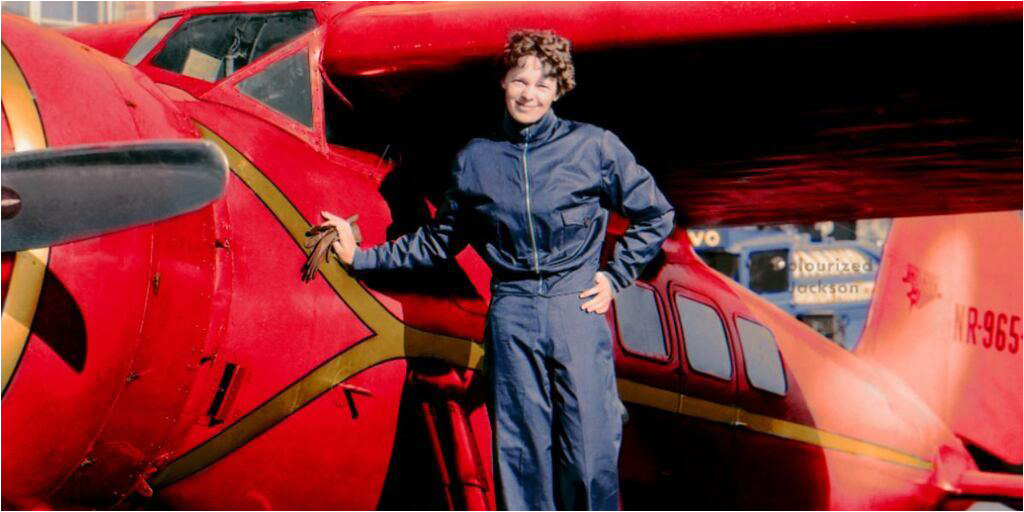
The first woman to fly solo across the Atlantic. The first woman to fly nonstop across America. The first person to fly solo from Hawaii to the mainland. An extraordinary sequence of aviation records—and one final expedition that became history’s greatest aviation mystery.
On January 11, 1935, a small red airplane lifted off from Wheeler Field in Hawaii and headed east across the Pacific Ocean.
At the controls was a 37-year-old American woman named Amelia Earhart.
Ahead lay approximately 2,400 miles of open ocean.
There were no emergency landing fields, no modern satellite navigation systems, and no possibility of summoning a rescue helicopter if the engine failed.
Several aviators had already died attempting the dangerous route between Hawaii and the North American mainland.
Earhart understood the risks.
But she also understood something that had become central to her extraordinary career.
Every successful flight into previously uncharted territory helped expand the possibilities of aviation.
Approximately eighteen hours later, she landed safely in Oakland, California.
She had become the first person—man or woman—to fly solo from Hawaii to the mainland United States.
It was another remarkable victory in a sequence of aviation accomplishments that had begun years earlier.
By 1935, Earhart had already crossed the Atlantic twice by air, including once alone. She had set women’s altitude and speed records, flown nonstop across the United States, and become an international symbol of aviation’s possibilities.
Her achievements challenged the assumptions of an era when professional aviation remained overwhelmingly male.
Yet the most extraordinary part of her story was still ahead.
In 1937, Earhart would attempt an ambitious flight around the world, following a route close to the equator.
She would complete approximately 22,000 miles before disappearing over the Pacific Ocean with navigator Fred Noonan.
Her fate remains one of the twentieth century’s enduring mysteries.
But Amelia Earhart deserves to be remembered for far more than the flight she never finished.
Her greatest legacy is the extraordinary sequence of flights she completed.
This is the story of a woman who repeatedly demonstrated that the boundaries of human achievement were not as fixed as the world believed.
The Making of an American Pioneer
Amelia Mary Earhart was born on July 24, 1897, in Atchison, Kansas.
Her childhood coincided with one of history’s most remarkable periods of technological transformation.
Automobiles were beginning to replace horses.
Electricity was changing American cities.
And in 1903, when Amelia was just six years old, Orville and Wilbur Wright completed the first sustained, controlled flight of a powered aircraft.
Humanity had entered the age of aviation.
Earhart’s own fascination with flying developed later.
In December 1920, she took a passenger flight at an airfield in Long Beach, California.
The experience transformed her ambitions.
She began flying lessons in January 1921 under instructor Neta Snook, one of the relatively few women then working as professional pilots.
To finance her training, Earhart took various jobs and saved her earnings.
Later that year, she purchased a secondhand Kinner Airster biplane.
Its bright yellow color inspired the nickname The Canary.
In 1922, she flew to an altitude of approximately 14,000 feet, establishing a women’s aviation altitude record.
In 1923, she received an international pilot’s license from the Fédération Aéronautique Internationale, becoming the sixteenth woman to receive that credential.
These were important early accomplishments.
But Earhart was still far from an international celebrity.
Her decisive breakthrough came in 1928.
Winning Streak No. 1: The Atlantic Crossing — 1928
The first woman to cross the Atlantic by air
On June 17, 1928, a Fokker trimotor aircraft named Friendship departed Trepassey, Newfoundland, for a flight across the Atlantic.
Aboard were three people: pilot Wilmer Stultz, mechanic and copilot Louis Gordon, and Amelia Earhart.
The flight was arranged to demonstrate that a woman could participate in a transatlantic aviation expedition.
Earhart was not the operating pilot during the ocean crossing.
Stultz and Gordon handled the aircraft.
After approximately twenty hours in the air, the Friendship landed in Wales on June 18.
Earhart had become the first woman to cross the Atlantic Ocean by airplane.
The accomplishment brought enormous publicity.
Newspapers celebrated her arrival.
Crowds welcomed her home.
Her resemblance to Charles Lindbergh, whose solo Atlantic crossing had captivated the world in 1927, helped generate the nickname Lady Lindy.
But Earhart recognized that she had not actually piloted the aircraft across the ocean.
She regarded the flight as an opportunity rather than the completion of her ambitions.
The experience gave her international visibility, but it also created a new determination.
Next time, she wanted to be at the controls.
Winning Streak Achievement No. 1: First woman to cross the Atlantic Ocean by airplane, June 1928.
It was the beginning of an extraordinary public career.
Winning Streak No. 2: Alone Across the Atlantic — 1932
The flight that proved she belonged among aviation’s great pioneers
Four years later, Earhart returned to the Atlantic.
This time, there would be no other pilot.
No navigator.
No mechanic.
She would fly alone.
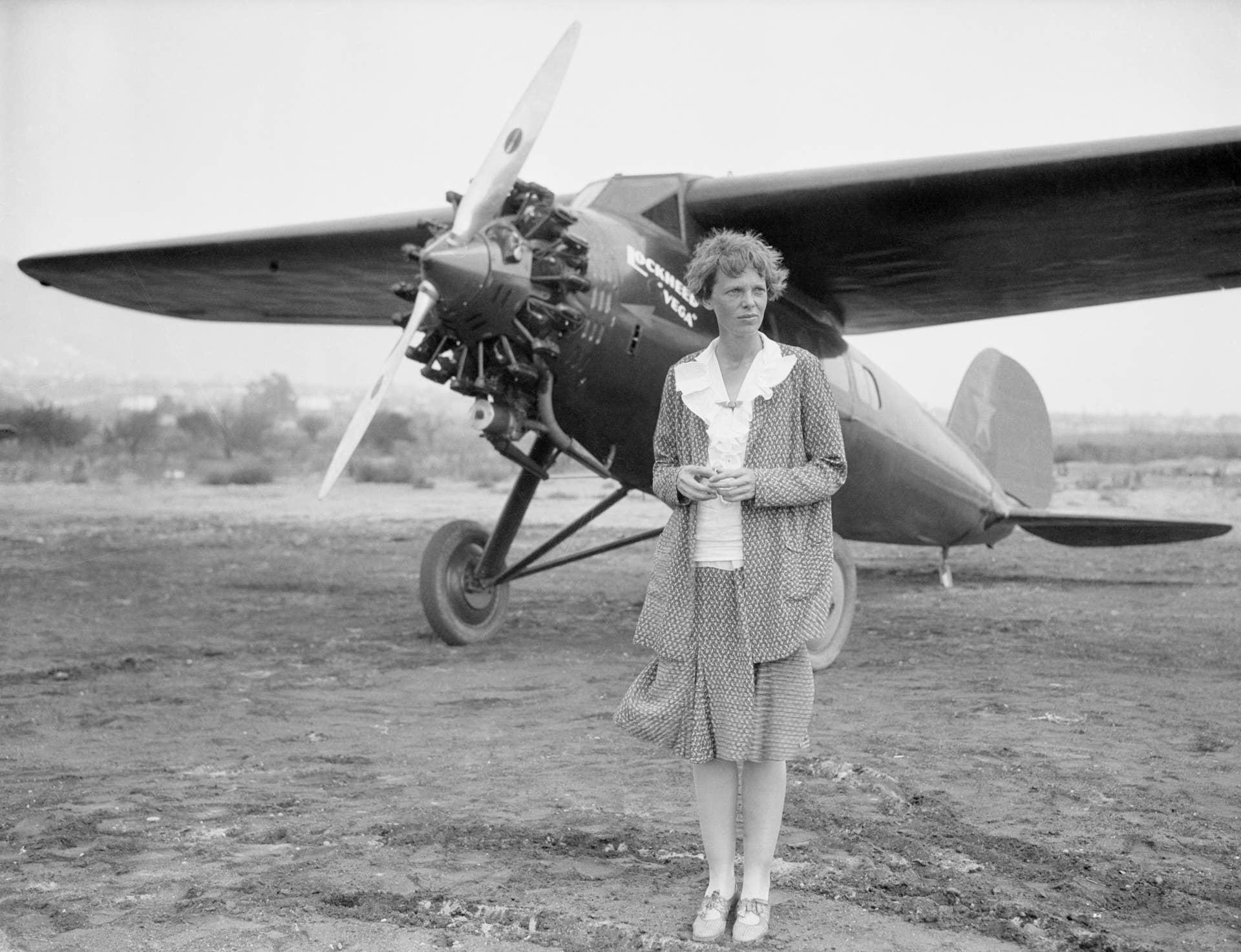
On May 20, 1932, exactly five years after Charles Lindbergh began his historic Atlantic flight, Earhart departed Harbor Grace, Newfoundland, aboard her bright red Lockheed Vega 5B.
Her intended destination was Paris.
The flight quickly became dangerous.
The aircraft encountered severe weather.
Ice accumulated on its surfaces, causing a loss of altitude.
Mechanical problems included a leaking fuel tank and a damaged engine manifold that sent flames outside the engine cowling.
Earhart was forced to contend with the combined dangers of fatigue, mechanical failure, and an unforgiving ocean.
But she continued.
After approximately fifteen hours, she reached the coast of Northern Ireland.
Unable to proceed safely to Paris, she landed in a field near Londonderry on May 21.
The landing was not the glamorous arrival she had originally envisioned.
But the achievement was extraordinary.
Amelia Earhart had become the first woman to fly solo and nonstop across the Atlantic Ocean.
She was also only the second person to accomplish the feat, following Charles Lindbergh.
The international response was tremendous.
Earhart received the Distinguished Flying Cross, becoming the first woman awarded that American military aviation decoration.
She also received the National Geographic Society’s gold medal and numerous international honors.
The significance extended beyond aviation.
Earhart had demonstrated that a woman could perform one of the most physically and mentally demanding flights of her era without assistance from another pilot.
Winning Streak Achievement No. 2: First woman to fly solo and nonstop across the Atlantic, May 20–21, 1932.
And she was not finished breaking records.
Winning Streak No. 3: Across America Without Stopping — August 1932
Coast to coast in nineteen hours
Just three months after her Atlantic triumph, Earhart pursued another aviation record.
This time, her objective was a nonstop transcontinental flight across the United States.
On August 24, 1932, she departed Los Angeles in her Lockheed Vega.
Her destination was Newark, New Jersey.
The route stretched approximately 2,447 miles across deserts, mountains, plains, and heavily populated areas.
Flying across America in the early 1930s was an entirely different experience from modern commercial aviation.
Weather information was limited.
Navigation depended upon instruments, maps, calculations, and visual landmarks.
Mechanical reliability could never be taken for granted.
Earhart completed the flight in 19 hours and 5 minutes.
She became the first woman to fly solo and nonstop across the continental United States.
It was another landmark achievement.
But what makes this story especially appropriate for Winning Streak is what happened next.
In July 1933, Earhart repeated the transcontinental flight.
This time, she completed the journey in approximately 17 hours and 7 minutes.
She had broken her own record.
The improvement demonstrated more than courage.
It reflected experience, preparation, and a willingness to return to an accomplishment already achieved and attempt to perform it better.
Winning Streak Achievement No. 3: First woman to fly solo nonstop across the United States in 1932—and an improved transcontinental record in 1933.
For Earhart, yesterday’s achievement was often the starting point for tomorrow’s ambition.
Winning Streak No. 4: The Pacific Ocean — January 1935
The most dangerous solo flight of her career
By the middle of the 1930s, Earhart had become one of the world’s best-known aviators.
But she continued seeking new challenges.
Her next objective was a solo flight from Hawaii to the mainland United States.
The distance was approximately 2,408 miles.
The route was especially dangerous because of the enormous expanse of open water separating Hawaii from California.
Unlike a transcontinental flight, there were no intermediate airports where a pilot could land in an emergency.
Previous attempts had ended in tragedy.
On January 11, 1935, Earhart departed Wheeler Field on Oahu in a Lockheed Vega.
She flew through the night, navigating over the Pacific toward California.
On January 12, she arrived safely in Oakland.
She had made history again.
Earhart was the first person to complete the Hawaii-to-mainland route alone.
She had also become the first person to have completed solo flights across both the Atlantic and the Pacific route between Hawaii and North America.
The achievement came during a period when commercial airlines were beginning to develop the infrastructure necessary for scheduled transoceanic service.
Earhart understood that long-distance record flights could contribute to the practical development of air transportation.
Her accomplishments were not simply personal adventures.
They helped demonstrate what increasingly capable aircraft and trained pilots might achieve.
Winning Streak Achievement No. 4: First person to fly solo from Hawaii to the United States mainland, January 11–12, 1935.
The woman who had conquered the Atlantic now had a Pacific aviation first to her name.
Winning Streak No. 5: Mexico and Another Two Records — 1935
An extraordinary year continues
Only months after her Pacific flight, Earhart returned to the cockpit for another series of pioneering journeys.
In April 1935, she became the first person to fly solo from Los Angeles to Mexico City.
The flight demonstrated her growing confidence in long-distance navigation across international borders.
Then, on May 8, she completed a solo nonstop flight from Mexico City to Newark, New Jersey.
Once again, she established an aviation first.
The sequence was extraordinary.
Within the first five months of 1935, Earhart had completed three significant pioneering flights:
- Hawaii to California.
- Los Angeles to Mexico City.
- Mexico City to Newark.
Each required careful preparation, fuel planning, navigation, and the ability to manage an aircraft alone over long distances.
Her success was no longer an isolated event.
It was becoming a repeatable pattern.
Winning Streak Achievement No. 5: Three pioneering solo long-distance flights in a single year.
Amelia Earhart had established herself not simply as a celebrity aviator, but as an accomplished long-distance pilot whose records repeatedly advanced the boundaries of aviation.
Beyond the Records: Opening the Skies to Women
Earhart’s influence extended far beyond the cockpit.
She understood that achieving aviation records could help challenge expectations about women’s capabilities and careers.
In 1929, she helped establish the Ninety-Nines, an international organization of women pilots.
She became its first president in 1931.
The organization created opportunities for women aviators to share knowledge, develop professional relationships, and advocate for greater participation in aviation.
Earhart also worked in aviation publishing, commercial airline promotion, and public speaking.
She wrote books about her flying experiences and became a prominent advocate for careers that were traditionally regarded as unsuitable for women.
In 1935, she joined Purdue University as a visiting faculty member.
Her responsibilities included advising women students about career opportunities and serving as a technical adviser in aeronautics.
The university connection was important.
Earhart was increasingly interested in aviation not merely as an individual pursuit, but as a field of scientific research and professional development.
With support from Purdue and private donors, she acquired a new twin-engine Lockheed Electra 10E.
She described the aircraft as a flying laboratory.
The airplane would provide the foundation for her most ambitious expedition.
She intended to fly around the world.
The Final Challenge: Around the World — 1937
An ambition greater than any previous record
By 1937, Amelia Earhart had already established an extraordinary aviation legacy.
But one immense challenge remained.
She wanted to circumnavigate the globe by aircraft along a route close to the equator.
Such a journey would be considerably longer than the more northerly routes used by earlier round-the-world flights.
The expedition would involve thousands of miles over remote oceans, difficult navigation, changing weather conditions, and limited landing facilities.
Earhart’s aircraft was a specially modified Lockheed Electra 10E, fitted with additional fuel tanks.
Her navigator for the decisive stages was Fred Noonan, an experienced aviation navigator who had worked on long-distance commercial routes.
The first attempt began in March 1937.
But after reaching Hawaii, the aircraft suffered serious damage during a takeoff accident at Luke Field.
The mission was abandoned while the Electra underwent extensive repairs.
It was an important setback.
Earhart had experienced another reminder that even the most experienced aviators could not eliminate every risk.
But she decided to try again.
On June 1, 1937, she began a second attempt from California, travelling eastward.
The route would take her through the United States, South America, Africa, India, Southeast Asia, Australia, and the Pacific.
Over the following month, Earhart and Noonan completed approximately 22,000 miles.
The expedition had reached Lae, New Guinea.
Only about 7,000 miles remained.
The most difficult part of the Pacific crossing was still ahead.
July 2, 1937: The Flight That Never Arrived
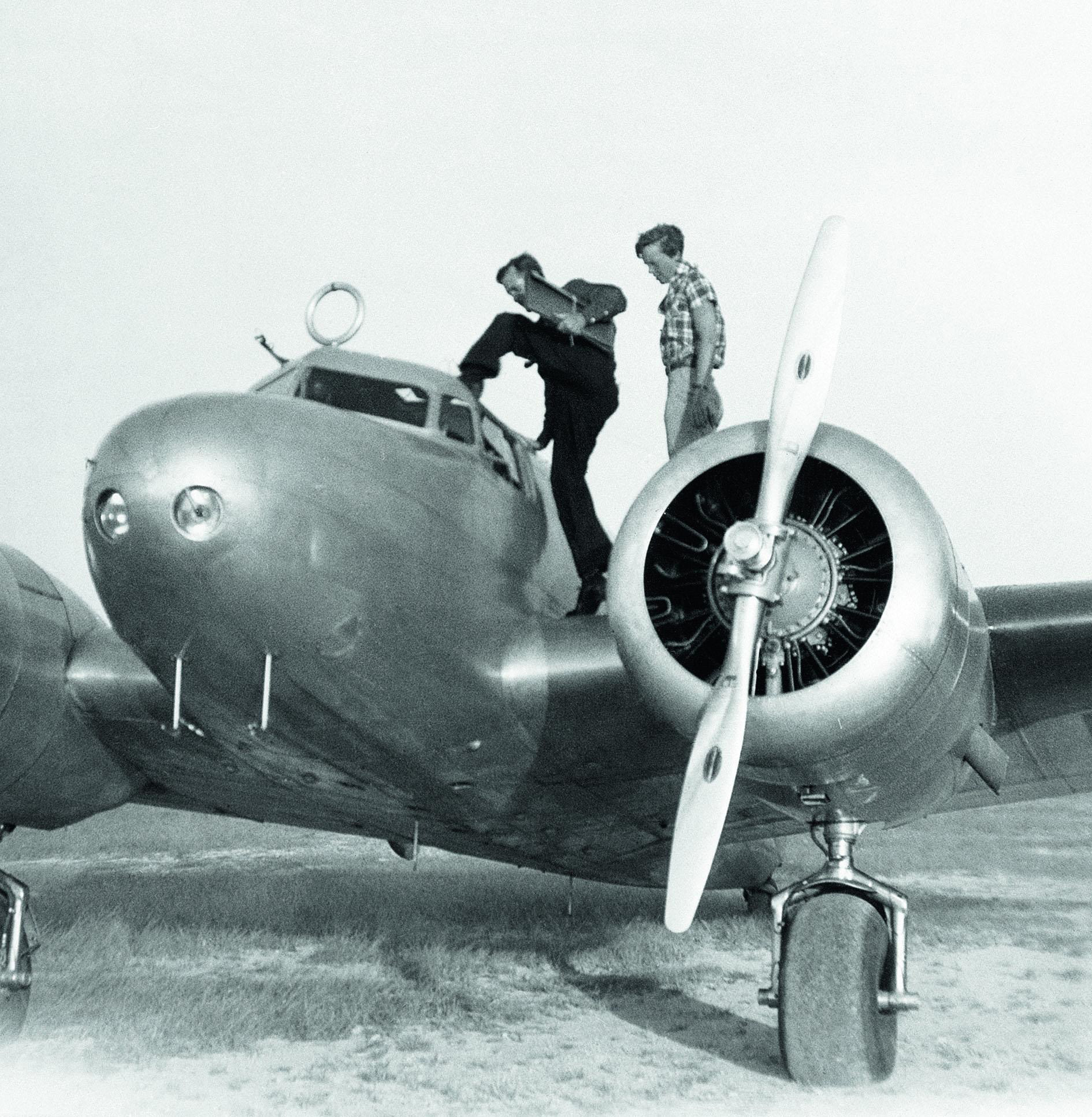
On July 2, Amelia Earhart and Fred Noonan departed Lae, New Guinea, for Howland Island.
The tiny island lay approximately 2,556 miles away in the central Pacific.
Howland was only about two miles long and less than one mile wide.
Locating such a small destination after a long overwater flight required exceptional navigational precision.
The United States Coast Guard cutter Itasca waited near the island to provide assistance and radio communications.
But difficulties developed.
The crew aboard the Itasca received transmissions from Earhart, yet effective two-way communication was never established.
The Electra’s position became increasingly uncertain.
Earhart reported difficulty locating Howland Island.
The last confirmed transmissions indicated that the aircraft was flying along a navigational line while searching for land.
Then the radio fell silent.
The Lockheed Electra never arrived.
An extensive search followed.
American naval and Coast Guard vessels searched enormous areas of the Pacific Ocean.
Aircraft flew over islands and surrounding waters.
But no confirmed wreckage was discovered.
On July 19, 1937, the official search was ended.
Earhart and Noonan were presumed lost at sea.
They were never found.
The Mystery That Overshadowed the Achievements
For nearly ninety years, the disappearance of Amelia Earhart has inspired investigation, speculation, books, documentaries, and competing theories.
Some researchers have suggested that she and Noonan landed on a remote Pacific island.
Others have explored reports of possible wreckage, unusual radio transmissions, or alternative routes.
The most widely accepted explanation is that the aircraft failed to locate Howland Island, exhausted its fuel, and crashed or was forced down into the ocean.
The Smithsonian’s National Air and Space Museum regards that explanation as the most reasonable interpretation of the available evidence.
However, the aircraft’s final resting place has not been conclusively established.
No definitive discovery has resolved the mystery.
The uncertainty is historically important.
But it should not eclipse the documented achievements that came before it.
Earhart’s aviation career deserves evaluation based on the records she completed, not merely the expedition that ended in disappearance.
Her firsts were real.
Her technical accomplishments were documented.
Her influence upon women in aviation was profound.
The mystery of her final flight should never become more important than the history of the flights she successfully completed.
The Psychology Behind Amelia Earhart’s Winning Streak
What made Earhart capable of achieving so many aviation firsts in such a short period?
The historical record reveals several recurring characteristics.
1. The Ability to Turn Experience Into Greater Ambition
Her 1928 Atlantic crossing introduced her to the realities of transoceanic flight.
Four years later, she returned to the same ocean as the pilot.
After completing her first solo transcontinental flight, she repeated the route and improved her time.
Each accomplishment helped create the experience and confidence necessary to attempt something more demanding.
2. Preparation Under Conditions of Uncertainty
Long-distance aviation in the 1930s required constant attention to weather, fuel, aircraft systems, navigation, and personal endurance.
Earhart’s flights were never guaranteed to succeed.
But successful planning increased the likelihood of completing difficult missions.
Her achievements reflected a combination of courage, practical skill, and preparation.
3. The Willingness to Challenge Established Assumptions
Earhart developed her career during an era when many people questioned whether women belonged in professional aviation.
She did not defeat those assumptions through arguments alone.
She challenged them through documented performance.
The records provided measurable evidence that female pilots could accomplish demanding aviation missions.
4. Understanding the Power of Public Achievement
Earhart recognized that a record-setting flight could attract attention to causes larger than the individual pilot.
Her fame helped generate support for women in aviation, commercial air travel, and broader professional opportunities.
She combined personal ambition with public advocacy.
5. Persistence After Setbacks
Her early aviation career required sacrifices and financial uncertainty.
Her Atlantic flight encountered serious mechanical and weather problems.
Her first attempt to circumnavigate the globe ended in an aircraft accident.
Yet she repeatedly returned to aviation.
Her perseverance did not guarantee success, as her final expedition demonstrated.
But it contributed to an extraordinary series of completed accomplishments.
The Winning Streak Legacy
Amelia Earhart’s aviation records were established during a period when flight itself was still an emerging technology.
The Wright brothers’ first powered flight had occurred only thirty-four years before her disappearance.
Commercial aviation was developing.
Long-distance navigation remained dangerous.
Aircraft reliability was improving, but mechanical failure could still be fatal.
Against that background, Earhart completed a series of achievements that reshaped public perceptions of who could become a successful aviator.
Her winning streak included:
- 1922: Women’s altitude record of approximately 14,000 feet.
- 1928: First woman to cross the Atlantic Ocean by airplane.
- 1932: First woman to fly solo nonstop across the Atlantic.
- 1932: First woman to fly solo nonstop across the United States.
- 1933: Improved her own transcontinental flight record.
- 1935: First person to fly solo from Hawaii to the mainland United States.
- 1935: First person to fly solo from Los Angeles to Mexico City.
- 1935: First person to fly solo nonstop from Mexico City to Newark.
These were not consecutive victories over opponents in a conventional sporting competition.
They were successive aviation achievements, many of which had never previously been accomplished.
They demonstrate a different kind of winning streak: the repeated ability to expand the boundaries of what was considered possible.
There were other outstanding women aviators whose achievements contributed to the development of aviation, including Bessie Coleman, Louise Thaden, Ruth Nichols, and Jacqueline Cochran.
Earhart’s accomplishments belong within that broader history of pioneering flight.
Her particular contribution was to combine record-setting performance with extraordinary public visibility.
She became a symbol of an era in which technology was challenging geographic boundaries, and women were challenging social ones.
Her disappearance created a mystery.
But her life established a legacy.
Amelia Earhart (1897–1937). The first woman to fly solo across the Atlantic. The first woman to fly solo nonstop across America. The first person to fly solo from Hawaii to the American mainland. A pioneer whose achievements crossed oceans and generations.
For Winning Streak, the greatest lesson of Amelia Earhart’s story is not that ambition always ends in victory.
It is that remarkable people can repeatedly expand the limits of human achievement—even when the ultimate outcome remains uncertain.
Amelia Earhart did not complete her final flight around the world. But she had already changed the world she was attempting to circle.
Winning Streak chronicles remarkable consecutive achievements, investigating the history, individuals, decisions, and circumstances that made them possible.
Historical Research & References
- Smithsonian National Air and Space Museum — Amelia Earhart — Early aviation career, records, and historic flights.
- Smithsonian — Lockheed Vega 5B — The aircraft used in her 1932 Atlantic and transcontinental flights.
- Purdue University — Amelia Earhart Collection — Biography, professional achievements, and the world-flight expedition.
- Purdue University Archives — Amelia Earhart at Purdue — Her teaching, research, and aviation advisory work.
- National Park Service — Amelia Earhart Birthplace — Early life and major aviation records.
- Smithsonian — Amelia Earhart: Missing for 80 Years but Not Forgotten — Documentation of the 1937 final flight and disappearance.
- The Ninety-Nines — International Organization of Women Pilots — The women pilots’ organization Earhart helped establish.