
From the Pietà to the Sistine Chapel, one Renaissance genius spent a lifetime achieving what others believed impossible.
History remembers great artists for their masterpieces. But few artists have produced a succession of achievements as extraordinary as Michelangelo Buonarroti (1475–1564).
For more than six decades, the Italian sculptor, painter, architect, and poet repeatedly redefined the limits of human creativity. Each major achievement seemed impossible to surpass. Then Michelangelo would undertake something even more ambitious.
His winning streak was not measured in championships, elections, or military conquests. It was measured in marble, frescoes, monumental buildings, and an artistic legacy that has endured for five centuries.
And remarkably, some of his greatest achievements came long after most Renaissance artists would have retired.
Victory No. 1: The Pietà — A Masterpiece at 24 (1498–1499)
Michelangelo was only 23 when he began carving the Pietà, commissioned by a French cardinal for a chapel in the old St. Peter’s Basilica in Rome.
The sculpture depicts the Virgin Mary holding the lifeless body of Jesus Christ.
From a single block of Carrara marble, Michelangelo created something astonishing: stone that seemed to possess the softness of human flesh, the movement of flowing fabric, and the emotional power of profound grief.
Completed around 1499, when Michelangelo was 24, the Pietà established him among the leading sculptors of his generation.
It is also the only work he is known to have signed.
The first great victory was complete. But his next achievement would be even more audacious.
Victory No. 2: David — Turning Rejected Marble into Immortality (1501–1504)
In 1501, Michelangelo accepted a challenge in Florence that other sculptors had abandoned.
A massive block of marble, already partially worked by previous artists, had stood unused for decades.
Michelangelo saw opportunity where others had encountered difficulty.
Over approximately three years, he transformed the stone into David, a monumental sculpture standing more than five metres tall.
Unlike traditional interpretations depicting the biblical hero after defeating Goliath, Michelangelo captured David before the confrontation.
His expression is watchful. His body is tense. His mind appears completely focused on the challenge ahead.
It was the psychology of victory translated into marble.
Unveiled in 1504, David became a symbol of Florence’s independence and determination.
Michelangelo was just 29 years old.
Within five years, he had produced two of the most celebrated marble sculptures in Western history.
Victory No. 3: The Sistine Chapel — Four Years That Changed Painting (1508–1512)
In 1508, Pope Julius II commissioned Michelangelo to paint the ceiling of the Sistine Chapel.
There was one significant complication.
Michelangelo regarded himself primarily as a sculptor, not a painter.
The ceiling presented a monumental technical and artistic challenge. Working on scaffolding high above the chapel floor, he developed an extraordinary composition illustrating scenes from the Book of Genesis.
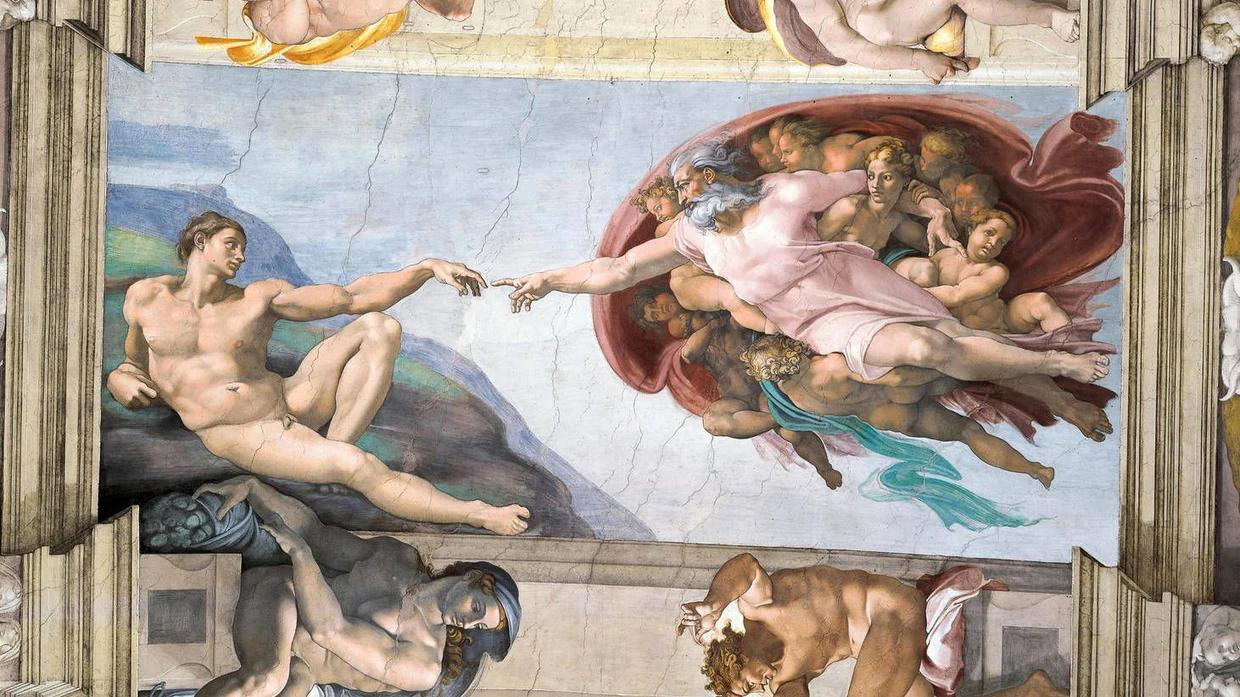
Among its most famous images is The Creation of Adam, depicting the nearly touching hands of God and man.
Michelangelo’s figures possessed a sculptural power unlike anything previously seen in monumental fresco painting.
After four demanding years, the completed ceiling was revealed in 1512.
The achievement transformed the possibilities of Renaissance painting and profoundly influenced generations of artists.
A sculptor had created one of the greatest paintings in history.
And the remarkable streak continued.
Victory No. 4: The Medici Chapel — Sculpture Becomes Architecture (1519–1534)
Michelangelo’s next extraordinary challenge was to combine architecture and sculpture into a unified artistic experience.
At the Medici Chapel in Florence, he designed a remarkable setting for the tombs of members of the powerful Medici family.
His allegorical sculptures included Night, Day, Dawn, and Dusk.
These figures were more than decorative monuments. They represented the passing of time, human mortality, and the tensions between earthly achievement and eternity.
During this period, Michelangelo also developed the architectural designs for the Laurentian Library.
Although significant portions of these projects remained unfinished when he departed Florence, his innovative treatment of architectural space helped open the door to a new artistic language.
He was no longer simply mastering individual disciplines.
He was redefining the relationships between them.
Victory No. 5: The Last Judgment — A Return to Greatness (1536–1541)
More than two decades after completing the Sistine Chapel ceiling, Michelangelo returned to paint its enormous altar wall.
He was now in his sixties.
The result was The Last Judgment, an overwhelming composition portraying the Second Coming of Christ and the final judgment of humanity.
The fresco contained hundreds of powerful, twisting human figures in a turbulent vision of salvation and damnation.
Completed in 1541, it was simultaneously admired and criticized, especially for its extensive nudity.
Michelangelo had produced another monumental masterpiece, this time with a darker and more searching vision of the human condition.
While younger artists pursued the innovations he had inspired, Michelangelo continued expanding his own artistic boundaries.
Victory No. 6: St. Peter’s Basilica — The Architect in His Seventies (1547–1564)
Most remarkable of all was Michelangelo’s final great professional chapter.
In 1547, at approximately 72 years of age, he was appointed chief architect of St. Peter’s Basilica in Rome.
The immense project had already occupied generations of architects.
Michelangelo reworked the design, emphasizing structural unity and monumental strength. His vision for the basilica’s great dome became one of the defining achievements of Renaissance architecture.
He would not live to see the dome completed.
Nevertheless, his plans and architectural leadership decisively shaped the building that stands today.
Well into his eighties, Michelangelo continued working, drawing, designing, and sculpting.
His unfinished Rondanini Pietà, on which he worked near the end of his life, reveals an artist still searching for new ways to express the human spirit.
Michelangelo died on February 18, 1564, at the age of 88.
His creative ambition had survived nearly to his final breath.
The Winning Streak Behind the Masterpieces
Michelangelo’s career was not an uninterrupted series of successes.
He endured political upheaval, difficult patrons, fierce professional rivalries, financial disputes, and ambitious commissions that were never completed as originally planned.
The troubled tomb of Pope Julius II, which occupied him intermittently for decades, became one of his greatest frustrations.
Yet these setbacks make the scale of his accomplishments more remarkable.
Consider the extraordinary progression:
| Period | Defining achievement |
|---|---|
| 1498–1499 | Pietà — Early sculptural masterpiece |
| 1501–1504 | David — Monumental achievement in marble |
| 1508–1512 | Sistine Chapel ceiling — Revolution in painting |
| 1519–1534 | Medici Chapel — Fusion of sculpture and architecture |
| 1536–1541 | The Last Judgment — Monumental late-career fresco |
| 1547–1564 | St. Peter’s Basilica — Architectural leadership and legacy |
The pattern is unmistakable.
Where others specialized, Michelangelo excelled across disciplines. Where others repeated successful formulas, he attempted increasingly demanding work.
And where age might have diminished ambition, his creative determination endured.
The Winning Streak Verdict
Michelangelo’s greatest victory was not the completion of any single masterpiece.
It was the extraordinary longevity of his creative excellence.
From the youthful triumph of the Pietà to the monumental architectural challenges of St. Peter’s Basilica, he sustained a remarkable sequence of accomplishments across approximately 65 years.
Five centuries later, millions still travel to Florence and Rome to witness his creations.
His work continues to inspire artists, architects, historians, and anyone who believes that extraordinary achievement is the result of imagination combined with relentless dedication.
Michelangelo did not simply create masterpieces. He spent a lifetime raising the standard of what a masterpiece could be.
That is a winning streak worthy of history.
Winning Streak explores remarkable sequences of human achievement and the people whose determination, ingenuity, and excellence changed history.