
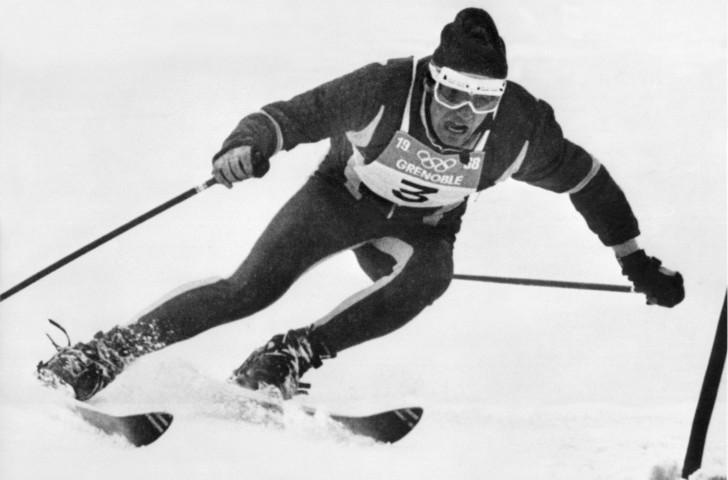
How a French skiing sensation won 12 World Cup races in one season, captured three Olympic gold medals, and created one of the most extraordinary winning streaks in winter sports history.
In February 1968, the mountains above Grenoble, France, became the stage for one of sport’s most remarkable demonstrations of dominance. A 24-year-old Frenchman named Jean-Claude Killy arrived at the Winter Olympics carrying the expectations of an entire nation. He departed with three gold medals, having won every men’s Alpine skiing event on the Olympic program.
Downhill. Giant slalom. Slalom.
Three different disciplines. Three different tests of courage, technique, and precision. Three victories.
But the Olympic sweep was not an isolated achievement. It was the culmination of a winning streak that had already transformed competitive skiing.
From Val d’Isère to the World Stage
Born on August 30, 1943, in Saint-Cloud, France, Jean-Claude Killy grew up in the Alpine resort of Val d’Isère, where skiing was a way of life.
His father moved the family to the mountains when Jean-Claude was a small child. Surrounded by snow and steep terrain, the young skier developed an instinctive familiarity with the mountains.
His first Olympic appearance, at Innsbruck in 1964, produced no medals. His best result was fifth place in the giant slalom, while he finished a distant 42nd in the downhill.
For a future legend, it was a modest beginning.
But Killy was still developing. He possessed something that would soon separate him from his competitors: the ability to attack a mountain at tremendous speed without surrendering the precision necessary to win.
In 1966, at the World Championships in Portillo, Chile, he captured gold medals in the downhill and Alpine combined.
The breakthrough had arrived.
1967: Twelve Victories in Seventeen Races
The inaugural Alpine Ski World Cup season of 1967 offered Killy an opportunity to establish himself against the finest racers in the world.
He did considerably more than that.
Killy won 12 of the season’s 17 World Cup races — an astonishing winning rate of approximately 71 percent.
He swept all five downhill races and won four of the five giant slalom competitions. His performances also secured the slalom season title, giving him the overall championship and all three individual discipline titles.
This was not merely a winning season. It was a demonstration of mastery across the entire Alpine racing program.
Downhill demanded fearlessness at extreme speed.
Giant slalom required flowing precision through sweeping turns.
Slalom tested lightning-fast reactions through tightly spaced gates.
Most champions specialized. Killy conquered all three.
His name became synonymous with victory, and his dominance gave the newly established World Cup an international superstar.
Yet the greatest test remained ahead.
Grenoble 1968: Three Races, Three Gold Medals
The 1968 Winter Olympics returned to France, and expectations surrounding Killy were enormous.
Twelve years earlier, Austria’s Toni Sailer had accomplished an unprecedented Olympic Alpine sweep at Cortina d’Ampezzo in 1956.
Could Killy equal it?
The competition unfolded at Chamrousse, high above Grenoble.
February 9 — Downhill Gold
Killy attacked the downhill course and completed his run in 1 minute, 59.85 seconds.
His French teammate Guy Périllat finished just 0.08 seconds behind.
Eight hundredths of a second separated Olympic gold from silver.
Killy had his first victory.
February 12 — Giant Slalom Gold
The giant slalom demanded two technically demanding runs, introducing a different challenge from the pure speed of downhill.
Killy won decisively, finishing 2.22 seconds ahead of Switzerland’s Willy Favre.
Two races. Two gold medals.
February 17 — Slalom Gold
The final event was far from straightforward.
Heavy fog disrupted the slalom competition, creating difficult conditions and one of the most controversial conclusions in Olympic skiing history.
Austria’s Karl Schranz appeared to threaten Killy’s lead but was ultimately disqualified after a disputed sequence involving a missed gate, an alleged obstruction, and a permitted rerun. Norway’s Håkon Mjøen was also disqualified after recording a competitive time.
The officials upheld Killy’s victory, although the controversy would remain part of the historical record.
Jean-Claude Killy had won all three Olympic Alpine skiing gold medals.
He also earned the 1968 World Championship title in the Alpine combined, which was then awarded separately from the Olympic medal events.
France had its national hero. The skiing world had witnessed history.
The Winning Streak by the Numbers
| Achievement | Result |
|---|---|
| 1966 World Championships | 2 gold medals |
| 1967 World Cup season | 12 victories in 17 races |
| 1967 World Cup titles | Overall, downhill, giant slalom, slalom |
| 1968 Winter Olympics | 3 gold medals |
| 1968 World Cup season | 6 victories and overall championship |
| World Cup overall championships | 2 consecutive titles |
In just two World Cup seasons, Killy accumulated 18 individual race victories and secured back-to-back overall championships.
He had become the defining champion of the competition’s earliest years.
Leaving the Mountain at the Summit
Perhaps the most unusual chapter of Killy’s story came immediately afterward.
Rather than spend another decade defending his supremacy, he stepped away from amateur competition at the end of the 1968 season.
He was only 24.
With three Olympic gold medals and two consecutive World Cup overall titles, Killy had little left to prove.
His fame soon extended beyond competitive skiing into endorsements, business, entertainment, and professional racing. He even returned to win a professional skiing world championship in 1973.
His influence on winter sports continued for decades.
Killy helped organize the 1992 Winter Olympics in Albertville, France, bringing the Games back to the Alpine region that had shaped his life. He later served as a member of the International Olympic Committee and held important responsibilities involving future Winter Games.
His second career demonstrated that the determination necessary to win sporting championships could also be applied to organizing and developing international sport.
What Made Killy’s Winning Streak Exceptional?
Some champions achieve greatness through longevity. Others establish records that survive for generations.
Jean-Claude Killy accomplished something different.
He compressed an extraordinary degree of excellence into a remarkably short competitive period.
His streak was exceptional for three reasons.
Versatility: He dominated three Alpine disciplines requiring substantially different technical and physical abilities.
Concentration: His 12 victories in the inaugural World Cup season represented a level of superiority rarely witnessed in a major international racing circuit.
Execution under pressure: He entered the 1968 Winter Olympics as the overwhelming favorite and fulfilled the expectations placed upon him, winning every Alpine event available to him.
His third Olympic gold was controversial, and his first was won by the smallest of margins. Those details make his accomplishment more historically interesting, not less.
The difference between winning and losing could be measured in hundredths of a second or a single missed gate.
Killy repeatedly found a way to finish first.
The Winning Streak Legacy
Jean-Claude Killy’s competitive reign was brief, but its influence endured.
He was one of the first great international stars of Alpine skiing’s World Cup era, a three-time Olympic gold medalist, and a champion whose victories helped bring the sport to a worldwide audience.
His story also offers an important lesson about the nature of winning streaks.
Greatness does not always require decades.
Sometimes, a competitor reaches a level of mastery so complete that a few extraordinary seasons are enough to establish a permanent place in history.
Between the emergence of the Alpine World Cup in 1967 and the closing days of the Grenoble Olympics in 1968, Jean-Claude Killy achieved precisely that.
For one extraordinary stretch of sporting history, the mountains belonged to Killy.
Winning Streak chronicles remarkable sequences of human achievement, investigating the discipline, decisions, and defining moments that made them possible.