
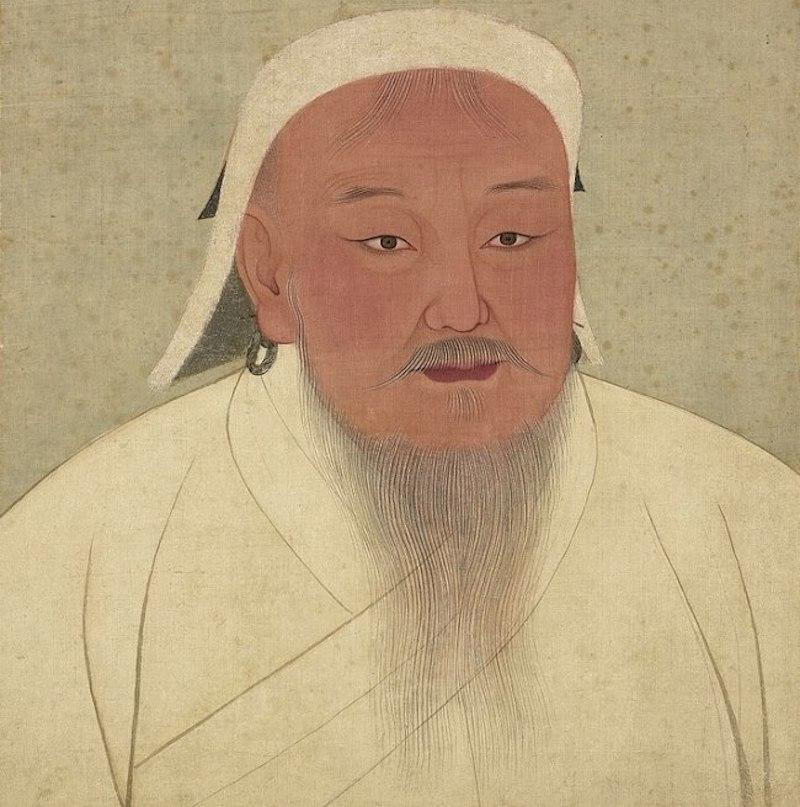
From an Outcast to the Conqueror of Empires
In 1206, a gathering of Mongolian tribal leaders proclaimed a warrior named Temüjin their supreme ruler.
He took the title Genghis Khan.
Twenty-one years later, he was dead. But the empire he founded stretched from northern China across Central Asia, while his commanders had carried Mongol arms into the Caucasus and the western Eurasian steppe.
His sons and grandsons would extend that empire even further, eventually controlling approximately 23 million square kilometres.
It became the largest contiguous land empire in recorded history.
The astonishing part is where the story began.
Genghis Khan was not born an emperor. He inherited no great kingdom, commanded no established national army, and possessed none of the wealth associated with the monarchies he would eventually defeat.
His childhood was marked by hardship. After his father’s death, his family was abandoned by former allies and struggled to survive.
He experienced captivity, shifting alliances, betrayal, and defeat.
And yet, out of the fragmented Mongolian steppe, he forged a military and political organization capable of defeating some of the world’s most powerful states.
His greatest victory was not the conquest of a city. It was the creation of a system that could keep winning after its founder was gone.
1202–1206: The First Great Victory — Uniting Mongolia
Before conquering foreign empires, Temüjin confronted a challenge closer to home.
Mongolia was divided among competing clans and confederations, including the Tatars, Kereit, Merkit, and Naiman.
These groups had longstanding rivalries and fiercely independent leaders.
Temüjin began eliminating or absorbing his competitors.
In 1202, he defeated the Tatars.
In 1203, he overcame the powerful Kereit alliance, once led by his ally Toghrul.
In 1204, he defeated the Naiman, removing one of his remaining major rivals.
His struggle against his former companion Jamukha also ended in Temüjin’s favor.
By 1206, the balance of power on the Mongolian steppe had fundamentally changed.
At a great assembly known as a kurultai, Temüjin was proclaimed Genghis Khan.
For the first time, the Mongol tribes possessed a broadly unified political and military leadership.
This was the foundation of every victory that followed.
1209: Victory Over Western Xia
The first major phase of imperial expansion targeted the Tangut kingdom of Western Xia, also called Xi Xia, in northwestern China.
The Tanguts controlled valuable territory and important routes connecting China and Central Asia.
Genghis Khan’s campaign in 1209 forced the Western Xia ruler to submit and accept Mongol overlordship.
The campaign also revealed a problem.
Mongol armies were superb at fighting in the open, but fortified cities required different skills.
They would need engineers, siege equipment, and specialists from the civilizations they encountered.
Rather than remaining exclusively a cavalry army, the Mongols gradually incorporated foreign expertise.
Their military capabilities expanded with their conquests.
The first major foreign campaign had provided both territory and lessons for future victories.
1211–1215: Breaking the Jin Dynasty’s Defenses
The Jurchen-led Jin dynasty controlled much of northern China.
It possessed fortified cities, sophisticated administration, considerable wealth, and a population far larger than the Mongols’.
In 1211, Genghis Khan launched a major invasion.
His armies exploited mobility, intelligence, coordinated offensives, and the political divisions within Jin territory.
They did not need to fight every enemy formation directly.
Instead, Mongol commanders isolated opponents, attacked vulnerable positions, and repeatedly disrupted Jin defenses.
In 1215, Mongol forces captured Zhongdu, near modern Beijing.
The Jin dynasty survived elsewhere until 1234, but the capture of its former capital marked an enormous strategic breakthrough.
Genghis Khan had demonstrated that the military power of the steppe could overcome the defenses of a major Chinese state.
1218: The Fall of Qara Khitai
The next great expansion moved westward.
Genghis Khan entrusted his general Jebe with operations against Qara Khitai, a Central Asian empire that occupied territories around modern Kazakhstan, Kyrgyzstan, and western China.
By 1218, Mongol forces had overcome its ruler, Kuchlug.
The conquest expanded Mongol influence along the Silk Road and brought the empire into direct contact with Khwarazm, one of the most powerful states in the Islamic world.
Another strategic barrier had fallen.
But the next war would be far more destructive.
1219–1221: The Destruction of the Khwarazmian Empire
The Khwarazmian Empire commanded an enormous territory extending across Central Asia and Iran.
Its great cities included Bukhara, Samarkand, and Urgench.
Genghis Khan initially pursued commercial relations, but the killing of members of a Mongol trading caravan at Otrar in 1218, followed by the mistreatment of his envoys, triggered a confrontation.
In 1219, he launched an invasion.
The Mongol armies advanced along multiple routes, confusing defenders and preventing the Khwarazmian ruler from concentrating his forces.
Bukhara fell in 1220.
Samarkand followed.
Other cities were besieged, captured, and devastated.
By 1221, Khwarazmian power had been shattered, although resistance continued under Jalal al-Din.
Militarily, the campaign demonstrated the extraordinary reach and coordination of the Mongol command system.
Humanly, it was catastrophic.
Cities were destroyed, large numbers of civilians were massacred or displaced, and entire regions suffered severe economic and demographic disruption.
Medieval chroniclers recorded enormous death tolls, although their precise figures remain disputed by historians.
The Khwarazmian campaign illustrates both sides of Genghis Khan’s legacy: remarkable strategic capability and devastating violence.
1223: The Battle of the Kalka River
Even while Genghis Khan consolidated his empire, his generals continued exploring and fighting across vast distances.
Two of his most capable commanders, Jebe and Subutai, conducted a remarkable expedition around the Caspian Sea and through the Caucasus.
In 1223, their forces confronted a coalition of Rus’ princes and Cuman-Kipchak allies near the Kalka River.
The Mongols achieved a decisive victory.
Genghis Khan did not personally command the battle.
That distinction is essential.
By this point, the Mongol military system no longer depended on the founder’s physical presence to produce major victories.
His commanders could operate independently, coordinate complicated maneuvers, and defeat powerful coalitions thousands of kilometres from Mongolia.
The winning streak had become institutional.
1226–1227: The Final Campaign
Genghis Khan’s last major campaign returned to Western Xia.
The Tangut kingdom had failed to satisfy Mongol expectations, and Genghis Khan moved to destroy its remaining independence.
His forces invaded in 1226.
By 1227, the Western Xia state was collapsing under the assault.
During the campaign, Genghis Khan died, traditionally dated to August 1227.
The precise cause of his death remains uncertain.
He was approximately 65 years old, although his exact birth year is disputed.
His burial place remains unknown.
His death marked the end of his personal campaigns, but not the end of Mongol expansion.
The Secret Behind the Winning Streak
How did a comparatively small population of nomadic horsemen repeatedly defeat powerful states?
The answer was not numerical superiority.
It was organization.
Genghis Khan and his commanders developed a military system built around several reinforcing advantages.
1. Merit and loyalty
Military appointments often rewarded demonstrated ability and loyalty rather than relying exclusively on hereditary rank.
Commanders such as Subutai and Jebe became central figures in Mongol victories.
2. Extraordinary mobility
Mongol warriors were accomplished horsemen, frequently travelling with multiple mounts.
Their armies could manoeuvre across immense distances while maintaining operational effectiveness.
3. Coordinated deception
Feigned retreats, encirclements, intelligence gathering, and carefully timed attacks helped the Mongols defeat larger or less flexible opponents.
4. A disciplined command structure
The army was organized into units based on tens, hundreds, thousands, and ten-thousands, making coordinated operations possible across different formations.
5. Adaptation
The Mongols incorporated engineers, administrators, artisans, and military specialists from conquered societies.
Their capabilities grew with the territory they controlled.
6. Psychological warfare
The reputation for ruthless punishment encouraged some cities to surrender without fighting.
It also imposed enormous suffering on populations that resisted.
These characteristics created a military organization capable of carrying out successive campaigns across widely differing geographical and political environments.
The Dynasty That Kept Winning
There is one extraordinary difference between Alexander the Great and Genghis Khan.
Alexander’s empire was divided among his successors after his death.
Genghis Khan’s descendants initially continued expanding the Mongol Empire.
His son Ögedei became Great Khan in 1229, directing further conquests across northern China and Eurasia.
His grandson Batu led campaigns that extended Mongol domination across much of the Rus’ principalities and into Eastern Europe.
Another grandson, Möngke, became Great Khan in 1251.
Hülegü conquered Baghdad in 1258.
Kublai Khan eventually established the Yuan dynasty in China in 1271.
The territorial height of the Mongol Empire came under Genghis Khan’s descendants, not during his own lifetime.
The dynasty eventually divided into separate political states, with rivalries and civil wars weakening central authority.
But for generations, the descendants of one Mongolian leader exercised power across an extraordinary portion of Eurasia.
The Legacy Beyond the Battlefield
The Mongol conquests brought destruction on a vast scale, but the empire also transformed Eurasian communication and exchange.
Under Genghis Khan and especially his successors, networks of roads, relay stations, merchants, administrators, and diplomatic envoys connected distant regions.
The period sometimes called the Pax Mongolica facilitated the movement of goods, people, technologies, religious traditions, and artistic influences along transcontinental routes.
Mongol rulers also demonstrated varying degrees of religious accommodation, often allowing different religious communities to practice under imperial authority.
These policies were pragmatic and uneven, not equivalent to modern principles of universal liberty.
The same empire that facilitated cultural exchange had been built through conquest, forced displacement, enslavement, and mass killing.
Both realities belong in its history.
The Winning Streak Verdict
Genghis Khan’s extraordinary achievement was not that he won every battle. His rise involved reversals, and the Mongol expansion was never an uninterrupted sequence of victories.
The remarkable historical pattern was his ability to turn successive campaigns into cumulative military, territorial, and organizational strength.
From the unification of Mongolia in 1206 to the destruction of Western Xia in 1227, he directed an expansion that fundamentally altered the political geography of Eurasia.
And unlike many conquerors, he established institutions and commanders capable of extending his empire after his death.
Alexander the Great demonstrated how far one brilliant commander could conquer in a lifetime. Genghis Khan demonstrated how a system of conquest could outlive its creator.
That is the defining distinction.
In just twenty-one years as Great Khan, a former outcast of the Mongolian steppe established the foundations of a dynasty whose territories would eventually stretch from the Pacific toward Central Europe.
His legacy combines extraordinary military organization, profound political transformation, and human suffering on a scale that must never be separated from his achievements.
For Winning Streak, he represents an exceptional historical phenomenon:
A succession of conquests that became a multigenerational imperial dynasty.
Winning Streak — Historical Intelligence
Discovering the consecutive achievements that changed history.
Historical References
- Royal Armouries — Rise of the Mongols
- National Geographic Education — The Mongol Khans
- OpenStax World History — Chinggis Khan and the Early Mongol Empire
- The Metropolitan Museum of Art — The Legacy of Genghis Khan
- The Cambridge History of the Mongol Empire — The Rise of Chinggis Khan and the United Empire, 1206–1260