
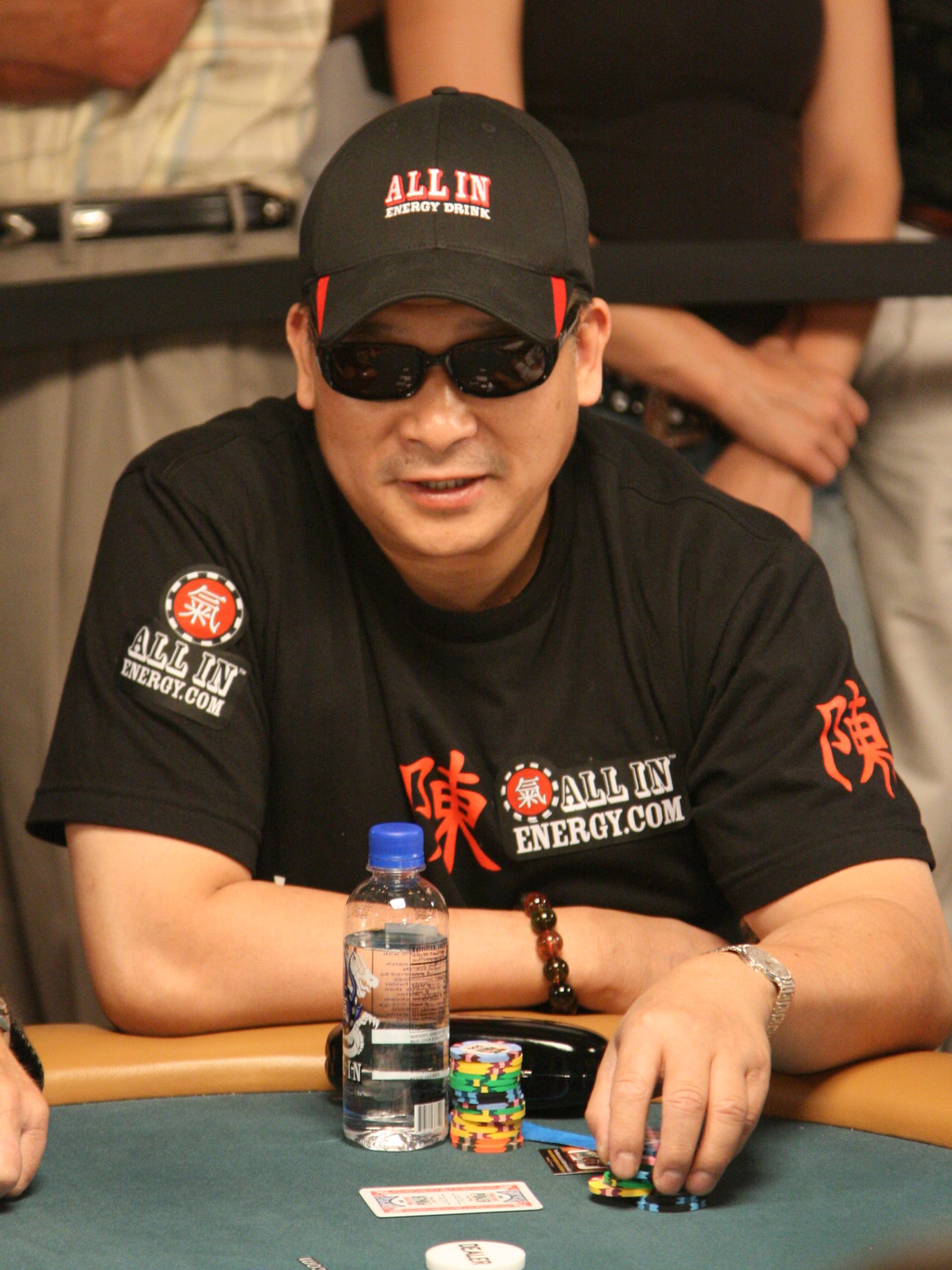
Two consecutive World Series of Poker championships. Three straight appearances in the final showdown. Ten career gold bracelets. The remarkable story of a master of competitive psychology who turned patience, calculated aggression, and human behavior into a historic winning streak.
In May 1989, inside Binion’s Horseshoe casino in downtown Las Vegas, one man stood on the verge of accomplishing something unprecedented in the history of professional poker.
His name was Johnny Chan.
For two consecutive years, the Chinese-born American poker professional had defeated the world’s leading competitors to capture the most prestigious championship in the game: the $10,000 No-Limit Texas Hold’em Main Event at the World Series of Poker.
In 1987, he conquered a field of 152 players.
In 1988, he returned and defeated 166 opponents to become world champion again.
Now, in 1989, he had survived another field of 178 competitors and reached the final confrontation for an astonishing third consecutive year.
Only one opponent remained: a confident 24-year-old challenger named Phil Hellmuth.
Another victory would give Chan three consecutive world championships, a feat no player had achieved.
But this remarkable story is about more than cards, chips, and championship money.
It is about the psychology of competition, the discipline of decision-making, and the extraordinary ability to understand another person’s intentions without knowing what cards they hold.
Johnny Chan had become a master of the invisible game taking place inside every player’s mind.
His three-year championship run remains one of poker’s most fascinating demonstrations of sustained competitive excellence.
The Making of the Orient Express
Johnny Chan was born on October 1, 1957, in Guangzhou, China.
His family moved to Hong Kong before immigrating to the United States in 1968, settling initially in Phoenix, Arizona, and later in Houston, Texas.
The family operated restaurants, where the young Chan became familiar with card games and the competitive atmosphere surrounding them.
As a teenager, he developed an intense interest in poker.
His early experiences in Las Vegas were far from an uninterrupted record of success.
One frequently recounted story describes a young Chan turning $500 into $20,000 during his first night of gambling, only to lose the entire amount the following evening.
The episode illustrates a lesson central to his later career: winning a large amount of money is not the same as becoming a consistently successful competitor.
Chan eventually abandoned his university studies and pursued professional poker in Las Vegas.
The environment was unforgiving.
Unlike chess, where both competitors can see the entire board, poker requires decisions based on incomplete information.
A player must assess probabilities, recognize patterns, interpret opponents’ behavior, and accept that even a mathematically favorable decision can produce an unfavorable result.
Chan learned to compete in this environment.
By the early 1980s, he had developed a reputation for aggressive tournament play.
At Bob Stupak’s America’s Cup of Poker, he became known for eliminating opponents with remarkable speed.
The performance helped earn him the nickname that would follow him throughout his career.
The Orient Express.
The name suggested an unstoppable force.
But Chan’s greatest achievements would demonstrate that knowing when to slow down was just as important as knowing when to attack.
Winning Streak No. 1: The 1987 World Championship
The World Series of Poker had been held annually in Las Vegas since 1970.
By 1987, its Main Event was firmly established as the game’s premier championship.
Each participant paid $10,000 to enter the No-Limit Texas Hold’em tournament.
Unlike games with fixed betting limits, no-limit poker allowed players to risk their entire remaining stack of chips on a single hand.
The format rewarded boldness, but reckless aggression could destroy days of patient effort in seconds.
Chan arrived in 1987 already holding one WSOP gold bracelet, earned by winning a Limit Hold’em tournament in 1985.
Yet winning the Main Event would represent a different level of accomplishment.
He began the championship against 151 other entrants, including some of poker’s most experienced professionals.
His progress was not effortless.
After the second day, Chan was ranked twentieth among the 24 remaining players.
He had to recover his position before reaching the decisive stage of the tournament.
By the final day, he had transformed that vulnerable position into a commanding opportunity.
Eventually, only two players remained: Johnny Chan and Frank Henderson of Houston.
In the championship’s final hand, Henderson held a pair of fours.
Chan held an ace and a nine.
The first four community cards failed to improve Chan’s hand.
Then came the river—the fifth and final community card.
A nine.
Chan had made a higher pair.
The championship was his.
He collected $625,000 and his second WSOP gold bracelet.
The final hand also demonstrated an essential truth about competitive poker: success requires skill across many decisions, but the result of an individual hand can still depend on chance.
Chan had navigated the tournament through sustained competitive judgment. A fortunate final card helped deliver the championship.
Winning Streak Achievement No. 1: World Series of Poker Main Event Champion, 1987.
The greatest test was still ahead.
Winning Streak No. 2: The 1988 Title Defense
Winning a major championship is difficult.
Defending it can be even harder.
Every opponent knows the defending champion’s reputation. Expectations increase, scrutiny intensifies, and the pressure to repeat success becomes part of the competition itself.
When Chan returned to Binion’s Horseshoe for the 1988 Main Event, the field had expanded to 167 players.
The defending champion was no longer simply another experienced competitor.
He was the man everyone wanted to defeat.
Nevertheless, Chan advanced through the tournament again.
Among the finalists was Erik Seidel, a talented New York player with a background in competitive backgammon who was making his first appearance in the WSOP Main Event.
Eventually, Chan and Seidel faced each other for the world championship.
Their final confrontation produced one of the most famous hands in poker history.
The Hand That Became a Hollywood Legend
In the decisive hand, Johnny Chan held the jack and nine of clubs.
Seidel held a queen and seven.
The first three community cards included a queen, ten, and eight.
Seidel had made top pair with his queen.
Chan had something far stronger.
A straight: eight, nine, ten, jack, queen.
Rather than revealing the strength of his position through overwhelming aggression, Chan allowed the hand to develop.
Seidel continued betting, believing his hand might be good enough to win.
When the crucial commitment came, Chan called.
Seidel discovered that his opponent had already secured the stronger hand.
The championship was over.
Chan had won $700,000 and a second consecutive Main Event title.
The psychological significance was unmistakable.
Chan did not need to bluff his opponent into surrendering.
He needed to allow Seidel to commit chips while holding a hand that appeared promising but was already beaten.
The sequence demonstrated a classic poker principle: sometimes the most effective move is to conceal strength and allow an opponent to act.
A decade later, footage of the hand appeared in the 1998 film Rounders, starring Matt Damon and Edward Norton.
The scene introduced an entirely new generation to Johnny Chan and became an iconic moment in poker cinema.
Winning Streak Achievement No. 2: World Series of Poker Main Event Champion, 1988.
Two consecutive world championships.
Two consecutive years of surviving the tournament’s entire field.
Chan had achieved something not seen at the Main Event since Doyle Brunson’s back-to-back titles in 1976 and 1977.
The possibility of a third consecutive victory was no longer unthinkable.
Winning Streak No. 3: The Extraordinary 1989 Final
When the 1989 World Series of Poker began, Johnny Chan entered with an opportunity to make history.
The tournament attracted 178 players, another increase in participation.
Every competitor understood what a third consecutive championship would mean.
Yet Chan continued advancing.
Once again, he survived the early stages.
Once again, he reached the final table.
And once again, he found himself competing for the game’s most prestigious title.
His final opponent was Phil Hellmuth, a 24-year-old American whose ambition and confidence matched his competitive talent.
The showdown represented a compelling contrast.
Chan was the established champion, defending a two-year reign.
Hellmuth was the challenger, seeking his first world championship.
The final hand became another memorable moment in poker history.
Hellmuth held a pair of nines.
Chan held an ace and seven of spades.
After a sequence of raises, the players committed their remaining chips.
This time, the community cards did not rescue Chan.
Hellmuth’s pair survived.
The young challenger became the 1989 World Series of Poker Main Event champion, collecting $755,000.
Chan finished second, earning $302,000 in official tournament prize money.
The dream of three consecutive titles had ended.
But something remarkable had already been accomplished.
For three straight years, Johnny Chan had reached the final two players in the world’s premier poker championship.
His results were first, first, and second.
Across three tournaments involving 152, 167, and 178 entrants respectively, Chan had repeatedly survived to the final confrontation.
No other player has matched that particular sequence of three consecutive Main Event heads-up appearances in the modern WSOP record.
His third year was technically a defeat.
Historically, it completed an extraordinary sequence.
The Psychology Behind the Winning Streak
What distinguished Johnny Chan from his competitors?
His career cannot be explained by a secret formula or the ability to read minds.
The historical evidence instead points toward several qualities that matter in sustained high-level poker competition.
1. Understanding Human Behavior
Poker is a game of incomplete information.
Players can see their own cards and the shared community cards, but not their opponents’ private holdings.
They must therefore interpret betting patterns, previous decisions, position, chip stacks, and the circumstances surrounding each confrontation.
The goal is not to know with certainty what an opponent holds.
It is to make better judgments than the opponent over many repeated decisions.
Chan’s aggressive reputation could complicate those judgments for his rivals.
An opponent facing the Orient Express had to consider whether a large bet represented a strong hand, a calculated bluff, or an attempt to exploit fear.
That uncertainty was part of his competitive advantage.
2. Patience Under Pressure
Chan’s 1988 victory over Erik Seidel remains an excellent illustration of the value of patience.
Holding an exceptionally strong hand, Chan did not have to force an immediate conclusion.
He allowed his opponent to continue making decisions.
The principle applies far beyond poker.
A competitor who acts too quickly can reveal information, abandon an advantage, or create unnecessary risk.
Sometimes restraint preserves more opportunities than aggression.
3. Calculated Aggression
Chan’s nickname reflected his ability to put opponents under pressure.
But aggression in poker is most effective when combined with selectivity.
The strongest competitors understand that every wager should serve a purpose.
Some bets seek to win immediately.
Others seek to extract additional value from a strong hand.
Still others discourage opponents from continuing with marginal holdings.
The challenge is knowing which objective applies.
Chan’s championship success suggests a rare ability to combine forceful play with the discipline to wait for favorable situations.
4. Emotional Control
Poker exposes competitors to a distinctive psychological challenge.
A player can make a sound decision and still lose because of an unfavorable card.
Conversely, poor decisions can sometimes produce short-term victories.
The resulting temptation is to confuse outcomes with decision quality.
Successful tournament players must recover from setbacks without allowing frustration to determine subsequent actions.
Chan’s progression from twentieth place among 24 remaining players in 1987 to eventual champion illustrates how tournament success can depend upon composure and recovery.
The ability to remain effective after adversity is itself a competitive skill.
5. Reputation as a Strategic Force
By 1989, Chan’s reputation preceded him.
Opponents knew that he had won the previous two Main Events.
They knew he was capable of aggressive play.
They also knew that he could patiently trap a challenger with a powerful hand.
That combination presented a difficult psychological problem.
Against an established champion, a competitor may become overly cautious, fearing elimination.
Another may become overly aggressive, trying to defeat the champion through spectacular moves.
A sophisticated player can adjust to either tendency.
Chan’s reputation did not guarantee victories. It gave opponents another factor to consider every time they confronted him.
The Orange on the Table
Among Johnny Chan’s most recognizable trademarks was a simple orange placed beside his chips.
For years, the fruit became part of his public image.
Some observers regarded it as a lucky charm.
The explanation was more practical.
Chan, a former smoker, disliked the heavy cigarette smoke common in poker rooms during that era.
He kept an orange nearby because its fresh scent provided relief from the surrounding smoke.
Eventually, the orange became an unmistakable personal symbol.
It is a small but revealing detail.
At the highest levels of competition, players often develop routines that help them manage an uncomfortable or distracting environment.
The orange did not make Chan a better player through supernatural luck.
It was part of the familiar surroundings he created for himself at the table.
Ten Gold Bracelets and a Place in History
Johnny Chan’s success did not end in 1989.
He continued competing in major tournaments, winning additional World Series of Poker events across several forms of the game.
His versatility was remarkable.
He won championships in Limit Hold’em, No-Limit Hold’em, Seven Card Stud, Deuce-to-Seven Draw, Pot-Limit Omaha, and Pot-Limit Hold’em.
In 2002, he was inducted into the Poker Hall of Fame.
In 2005, he became the first player to accumulate ten World Series of Poker gold bracelets.
The milestone confirmed that his success was not confined to one remarkable three-year period.
He had demonstrated competitive excellence across multiple decades, against evolving generations of opponents, and in formats requiring different technical abilities.
As poker experienced an enormous surge in popularity during the early twenty-first century, Chan’s accomplishments also gained wider recognition.
His appearance in Rounders had already helped connect his championship career with popular culture.
Now, millions of new players were discovering the game through television and online competition.
Chan’s reputation as one of poker’s defining champions was firmly established.
The Winning Streak Legacy
The enduring significance of Johnny Chan’s career lies in the distinction between winning once and repeatedly reaching the position to win.
An individual poker tournament contains enormous uncertainty.
Cards are shuffled randomly.
Opponents change.
A single confrontation can end a player’s championship hopes.
Even a highly skilled competitor cannot control every result.
What makes Chan’s record remarkable is that, despite those uncertainties, he returned to the same decisive position three consecutive years.
He won the Main Event in 1987.
He defended the title in 1988.
And in 1989, he came within one opponent of accomplishing an unprecedented third consecutive championship.
His record provides a valuable lesson about competitive psychology.
Long-term excellence does not necessarily mean winning every confrontation.
It means repeatedly making effective decisions, adapting to opponents, maintaining discipline, and positioning oneself for success.
The most memorable hand of his championship streak was a victory built on patience.
The final hand of his three-year run was a defeat determined by a showdown.
Together, they illustrate the essential character of poker: a contest in which skill shapes probabilities, psychology influences decisions, and uncertainty never entirely disappears.
Two consecutive world championships. Three consecutive heads-up appearances. Ten career World Series of Poker bracelets.
Few competitors have sustained such a distinguished record in a game where certainty is impossible.
Johnny Chan never completed the three-peat.
Yet his winning streak became one of the most compelling chapters in the history of competitive strategy.
Johnny Chan (born 1957). A master of competitive psychology. Three consecutive championship showdowns. One remarkable place in gaming history.
Winning Streak chronicles remarkable consecutive achievements, investigating the history, individuals, decisions, and circumstances that made them possible.