
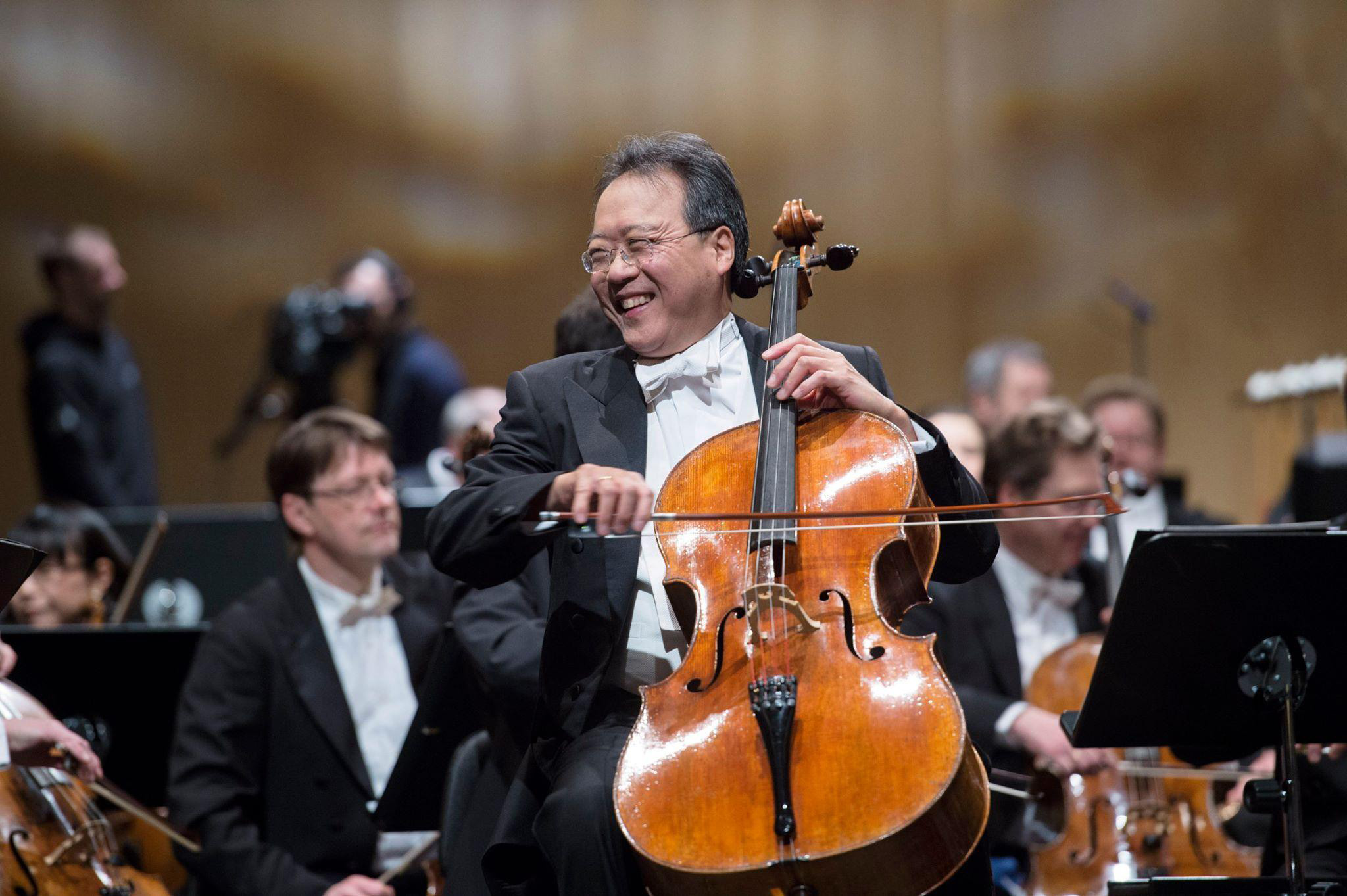
Twenty Grammy Awards. More than 120 albums. A cultural movement founded in 1998. Thirty-six communities across six continents united through Bach. The extraordinary story of a musical genius who transformed artistic excellence into a lifelong mission of peace and human understanding.
On April 13, 2019, one of the world’s most celebrated musicians appeared at an unusual concert venue.
Not Carnegie Hall.
Not the Royal Albert Hall.
Not the Sydney Opera House.
He stood at the international border between Laredo, Texas, and Nuevo Laredo, Mexico, carrying a centuries-old musical instrument.
His name was Yo-Yo Ma.
As political arguments about borders and immigration intensified, the Chinese-American cellist had travelled to the banks of the Rio Grande to perform Johann Sebastian Bach.
The occasion was part of an international musical initiative intended to demonstrate how culture could bring communities together.
For several minutes, the sound of a single cello carried a message that required no translation.
The music belonged neither exclusively to America nor to Mexico.
It belonged to anyone willing to listen.
The performance represented something remarkable about Yo-Yo Ma’s extraordinary career.
He had already achieved almost everything a classical musician could hope to accomplish.
He had performed in the world’s leading concert halls, worked with celebrated orchestras, recorded internationally acclaimed albums, and received some of the highest honors available to an American artist.
Yet he continued seeking new ways to use music.
Not simply to entertain.
Not merely to win awards.
But to create understanding between people divided by geography, politics, language, and tradition.
By 2026, Ma had accumulated twenty Grammy Awards across a recording career spanning more than four decades.
His international musical organization, Silkroad, had developed into an enduring experiment in cross-cultural collaboration.
And his Bach Project had carried one of classical music’s most treasured compositions into communities around the world.
For Winning Streak, Yo-Yo Ma represents a rare kind of consecutive achievement: a musician who repeatedly transformed artistic success into opportunities for human connection.
His greatest winning streak may not be the awards he collected.
It may be the bridges he continued building.
The Making of a Musical Genius
Yo-Yo Ma was born on October 7, 1955, in Paris, France, to Chinese parents.
His father, Hiao-Tsiun Ma, was a violinist, composer, and music teacher. His mother, Marina Lu, was a singer.
Music was an essential part of family life.
At just four years old, Yo-Yo began studying the cello under his father’s instruction.
His talent developed rapidly.
By the age of seven, after the family had moved to New York City, he was already attracting attention as an extraordinary young musician.
On November 29, 1962, he appeared at a nationally televised fundraising gala for the National Cultural Center, the institution that would eventually become the Kennedy Center for the Performing Arts.
Leonard Bernstein served as master of ceremonies.
Among those attending were President John F. Kennedy and former President Dwight D. Eisenhower.
Accompanied by his older sister, Yeou-Cheng Ma, the seven-year-old cellist performed before an audience that included some of America’s most prominent cultural and political figures.
It was a remarkable introduction to international public life.
But performing as a child prodigy was only the beginning.
Ma continued studying at the Juilliard School and later attended Harvard University, graduating in 1976.
His education reflected an expanding curiosity about the world beyond classical performance.
He became interested in history, anthropology, philosophy, and the connections between different cultural traditions.
Those interests would eventually transform his career.
The young cellist was not content merely to master an instrument.
He wanted to understand what music could reveal about humanity.
Winning Streak No. 1: Mastering the Cello — 1978 to 1984
From prodigy to internationally recognized artist
By the late 1970s, Yo-Yo Ma had established himself as one of classical music’s emerging stars.
In 1978, he received the prestigious Avery Fisher Prize, recognizing exceptional achievement among instrumentalists.
His performances were admired for their technical command, expressive warmth, and ability to communicate the emotional character of complex compositions.
Yet it was his relationship with the music of Johann Sebastian Bach that became particularly important.
Bach’s six suites for unaccompanied cello are among the most demanding and celebrated works in the classical repertoire.
They require the performer to create an entire musical world with a single instrument.
There is no orchestra to provide support.
No accompanying piano.
Only a musician, a cello, and the score.
Ma had studied the suites since childhood.
In the early 1980s, he recorded them for the first time.
His recording of the suites earned him his first Grammy Award in 1984.
It marked the beginning of an extraordinary sequence of recognition.
Over the decades, Ma would record the Bach suites three times, each interpretation reflecting a different stage in his artistic development.
The first represented a young virtuoso establishing his voice.
The second explored the relationship between Bach and other artistic disciplines.
The third, released in 2018 as Six Evolutions, reflected a mature artist reconsidering music that had accompanied him for almost his entire life.
This willingness to revisit familiar work was central to Ma’s artistic philosophy.
Mastery did not mean that a composition had nothing left to teach.
It meant that the musician could continue discovering new possibilities within it.
Winning Streak Achievement No. 1: An internationally distinguished performance career, beginning with major honors in 1978 and his first Grammy Award in 1984.
His next breakthrough would take him far beyond the traditional boundaries of classical music.
Winning Streak No. 2: Silkroad — A New Musical World, 1998
What happens when strangers create together?
In 1998, Yo-Yo Ma established the Silk Road Project, now known as Silkroad.
Its inspiration was the ancient network of trade routes connecting East Asia, Central Asia, the Middle East, and Europe.
For centuries, the Silk Roads had facilitated exchanges of goods, technologies, religions, ideas, and artistic traditions.
Ma saw an opportunity to reinterpret that historical network for the modern world.
What would happen if musicians from different cultures came together not simply to perform their traditional music, but to create something entirely new?
Could artistic collaboration become a model for cooperation across cultural boundaries?
These questions formed the foundation of Silkroad.
The project brought together virtuoso musicians representing traditions that rarely shared the same concert stage.
Chinese pipa players worked alongside Western string musicians.
Iranian kamancheh performers collaborated with artists from Europe and the Americas.
Composers experimented with instruments, rhythms, and musical languages developed across centuries of different cultural histories.
The results were sometimes surprising.
A classical cello might accompany a traditional Persian instrument.
A Chinese melody might become the foundation of a newly composed international ensemble work.
Musicians trained in entirely different systems of notation and improvisation learned to listen, negotiate, and create together.
The organization attracted extraordinary artists, including Chinese pipa virtuoso Wu Man, Iranian musician Kayhan Kalhor, Syrian clarinetist Kinan Azmeh, and Spanish bagpiper Cristina Pato.
These collaborations became more than an exploration of unusual sounds.
They required the participants to approach unfamiliar traditions with curiosity and respect.
No single cultural language could dominate every artistic decision.
The musicians had to discover a shared creative vocabulary.
That process became Silkroad’s greatest innovation.
Winning Streak Achievement No. 2: The creation of an international musical organization built around sustained cross-cultural collaboration.
What began in 1998 would grow into a worldwide artistic and educational institution.
Winning Streak No. 3: Music Becomes a Mission for Peace — 2006
Recognition from the United Nations
As Silkroad expanded, Yo-Yo Ma increasingly connected his artistic career with international cultural diplomacy.
In 2006, United Nations Secretary-General Kofi Annan appointed him a United Nations Messenger of Peace.
The designation recognized his efforts to promote cultural understanding and introduce young people to music.
It also gave Ma a platform to advocate for the importance of culture in international cooperation.
His message was straightforward.
People who do not share the same language, religion, nationality, or historical experience can still find ways to create something meaningful together.
Music offers one such opportunity.
But Ma’s approach was not based on the assumption that a concert could solve a war or eliminate political conflict.
Cultural understanding is not a substitute for diplomacy, security, or political negotiation.
Its contribution is different.
It creates opportunities for people to encounter one another as individuals rather than abstractions.
Silkroad’s educational work increasingly brought musicians into schools, universities, and communities that might otherwise have limited access to international artistic collaboration.
The organization also worked with refugee, Indigenous, and underserved communities.
Its activities connected professional performance with learning and social engagement.
Winning Streak Achievement No. 3: Appointment as a United Nations Messenger of Peace in 2006, extending the influence of his musical collaborations into international cultural advocacy.
Ma had become something more than a world-famous cellist.
He was now an advocate for the idea that culture could help strengthen the relationships upon which peaceful societies depend.
Winning Streak No. 4: A Grammy for Global Collaboration — 2017
The music of strangers becomes a triumph
By the middle of the 2010s, Silkroad had developed a substantial international reputation.
Its performances combined virtuosity with musical experimentation.
Its recordings introduced listeners to instruments and traditions often unfamiliar to mainstream Western classical audiences.
In 2016, the documentary The Music of Strangers: Yo-Yo Ma and the Silk Road Ensemble, directed by Academy Award-winning filmmaker Morgan Neville, brought the organization’s story to a wider audience.
The film explored the lives and artistic journeys of Ma and several of his collaborators.
Its central theme was not that cultural differences should disappear.
Rather, it demonstrated how those differences could become sources of creativity.
The same year, Silkroad released the album Sing Me Home.
The recording featured artists drawing upon diverse musical traditions and exploring the meaning of home, identity, and belonging.
At the 59th Grammy Awards in February 2017, Yo-Yo Ma and the Silk Road Ensemble won Best World Music Album for Sing Me Home.
It was a particularly significant victory.
Nearly two decades after Silkroad’s founding, the project had received one of the recording industry’s most recognizable honors.
But the award belonged to a collective of collaborators rather than an individual artistic vision alone.
The success illustrated the central principle upon which Silkroad had been established.
Extraordinary results could emerge when talented people with different experiences learned to create together.
Winning Streak Achievement No. 4: A Grammy-winning international collaboration, nearly nineteen years after the founding of Silkroad.
The institution had demonstrated a capacity to endure, evolve, and earn recognition across generations of performers.
Winning Streak No. 5: The Bach Project — 36 Communities, Six Continents
One cello travels the world
In August 2018, Ma began another ambitious international initiative.
He called it the Bach Project.
Its objective was to perform Bach’s six suites for unaccompanied cello in 36 locations across six continents, alongside community activities known as Days of Action.
The project began at Red Rocks Amphitheatre in Colorado.
But the underlying idea was not to present another conventional world concert tour.
Each destination would offer an opportunity to investigate how culture could strengthen local communities.
The project travelled through places including Mexico City, Mumbai, Athens, Nairobi, Sydney, Christchurch, and other cities.
Ma performed music that had been part of his life since childhood.
But the audiences, settings, and conversations were constantly changing.
The same six compositions became a way of opening new discussions.
What did community mean in one city?
How did a particular society preserve its heritage?
What could different cultures learn from one another?
And how could the arts help people confront the challenges of an increasingly divided world?
The most memorable illustration occurred in April 2019.
At the border between Laredo and Nuevo Laredo, Ma performed Bach as part of a cross-border cultural gathering.
The event brought together local artists and communities on both sides of the Rio Grande.
It was a deliberate expression of cultural connection at a place usually discussed in terms of political and geographic separation.
No treaty was signed.
No border dispute was resolved.
But the music created an occasion for people to recognize a shared cultural life.
Winning Streak Achievement No. 5: The Bach Project’s worldwide sequence of performances and community engagements, designed around 36 locations on six continents.
Ma was demonstrating that even a single musician performing centuries-old music could contribute to a contemporary conversation about human understanding.
Winning Streak No. 6: Songs of Comfort — 2020
When the concert halls went silent
In March 2020, the COVID-19 pandemic disrupted daily life around the world.
Concert halls closed.
Travel became restricted.
Professional musicians lost opportunities to perform.
Families, friends, and communities experienced prolonged isolation.
On March 13, 2020, Yo-Yo Ma began sharing short cello performances online under the hashtag #SongsOfComfort.
His first selection drew upon Antonín Dvořák’s music, offering a moment of reflection during a period of uncertainty.
The idea was simple.
If people could no longer gather to hear music, perhaps the music could reach them wherever they were.
The response spread rapidly.
Other musicians began sharing their own performances.
What started as an individual offering developed into an international movement.
Across the following months, the project reached millions of people.
Ma also joined pianist Emanuel Ax for informal performances honoring essential workers, including people serving in healthcare, transportation, and emergency services.
In December 2020, he released Songs of Comfort and Hope with longtime collaborator Kathryn Stott.
The album brought together twenty-one recordings drawn from classical music, traditional songs, jazz, and popular repertoire.
The achievement was not measured by ticket sales or competitive rankings.
It was measured by the ability to bring music into people’s lives when familiar forms of human connection had been interrupted.
Then came a small but unforgettable moment.
On March 13, 2021, exactly one year after launching #SongsOfComfort, Ma received his second COVID-19 vaccination at Berkshire Community College in Massachusetts.
During the customary observation period, he took out his cello and played for the people waiting nearby.
The performance included Bach and Schubert.
There was no formal concert stage.
No elaborate production.
No expensive ticket.
The internationally celebrated musician played in a vaccination clinic.
Winning Streak Achievement No. 6: A worldwide musical initiative that transformed isolation into an opportunity for collective artistic participation.
The modest clinic performance became one of the most recognizable expressions of his philosophy.
Music should not belong exclusively to concert halls.
It should remain part of everyday human life.
Winning Streak No. 7: Twenty Grammy Awards — 1984 to 2026
Forty-two years of recording excellence
On February 1, 2026, Yo-Yo Ma received another remarkable recognition.
At the 68th Annual Grammy Awards, his recording of Dmitri Shostakovich’s cello concertos with the Boston Symphony Orchestra, conducted by Andris Nelsons, won Best Classical Instrumental Solo.
It brought his career Grammy total to twenty wins.
His first Grammy had come in 1984.
The latest arrived forty-two years later.
Few artistic careers sustain such a long period of international recognition.
Ma’s recording catalog now extends beyond 120 albums.
It includes traditional classical works, experimental projects, film soundtracks, collaborations with folk and popular musicians, and recordings that cross conventional musical categories.
His awards include Grammys for classical instrumental performance, chamber music, contemporary folk, classical crossover, and world music.
The achievements reflect both longevity and an unusual willingness to explore unfamiliar territory.
Consider the contrast.
In 1984, the recording industry recognized Ma’s interpretation of Bach.
In 2017, it recognized the international collaborative achievement of Silkroad.
In 2026, it recognized his performance of Shostakovich.
Three different periods.
Three distinct musical contexts.
One continuing commitment to artistic excellence.
This was not a streak of twenty consecutive annual Grammy victories. The awards were earned across separate years and categories, with other artists winning in between.
The significance lies in the remarkable recurrence of achievement over more than four decades.
Winning Streak Achievement No. 7: Twenty Grammy Awards between 1984 and 2026, reflecting sustained artistic distinction across multiple musical traditions.
At 71, Yo-Yo Ma continued to demonstrate that artistic development need not end with fame, commercial success, or public recognition.
The Winning Streak That Never Required an Opponent
Unlike the champions celebrated elsewhere in the Winning Streak archive, Yo-Yo Ma’s career cannot be evaluated through match scores or an undefeated record.
There are no opponents to eliminate.
No championship brackets to survive.
No finishing lines to cross.
His record instead reveals something different about repeated achievement.
He consistently expanded the purpose and reach of his artistic work.
First, he established himself as a world-class musician.
Then he explored collaborations across musical genres.
He created an international cultural organization.
He became a United Nations Messenger of Peace.
He developed a worldwide series of community-centered performances.
He used music to provide comfort during a global emergency.
And he continued receiving major artistic recognition long after the beginning of his career.
The common feature was not a desire to defeat competitors.
It was the ability to discover new ways to contribute.
His legacy also depends upon the talents and contributions of many collaborators.
Silkroad’s achievements belong to its musicians, composers, educators, and organizational leaders, including artistic director Rhiannon Giddens.
The extraordinary music created through collaboration is not evidence that one individual possesses every answer.
It is evidence that talented people can achieve something distinctive when they listen to one another.
That may be the most important lesson of the entire enterprise.
The Art of Peace
What does it mean to build peace through music?
The answer requires historical care.
Music cannot guarantee reconciliation between nations.
A concert cannot reverse centuries of conflict.
A Grammy Award cannot measure the depth of understanding between communities.
Yet culture can create encounters that might otherwise never occur.
A Chinese-American musician can perform Bach at the border between the United States and Mexico.
An Iranian musician and a Syrian clarinetist can collaborate with performers trained in European classical traditions.
Students from different backgrounds can discover that artistic creativity requires listening as much as performing.
These events do not erase differences.
They create opportunities to engage with them.
That is the principle behind Silkroad.
The best collaborations do not require people to abandon their cultural identities.
They invite them to contribute those identities to something shared.
Ma’s work suggests that the arts can model habits valuable far beyond music: curiosity, patience, mutual respect, and cooperation.
For Winning Streak’s Art of Peace collection, that is a compelling form of historical achievement.
The Winning Streak Legacy
More than sixty years after his childhood performance before President John F. Kennedy, Yo-Yo Ma remains an extraordinary figure in the history of music.
His career has crossed generations of audiences, changing recording technologies, evolving artistic movements, and different political and cultural environments.
He has received major honors, including the National Medal of Arts, the Presidential Medal of Freedom, the Kennedy Center Honors, the Polar Music Prize, and the Birgit Nilsson Prize.
But perhaps his most important achievement is that he used an exceptional artistic career to create opportunities for others.
Silkroad became an enduring institution.
The Bach Project connected musical performance with community engagement.
Songs of Comfort demonstrated how individuals could use artistic expression to support one another during a global crisis.
And the twenty Grammy Awards confirm a remarkable consistency of artistic accomplishment across forty-two years.
The central lesson of this winning streak is different from the stories of undefeated athletes or military commanders.
It is a reminder that greatness can be sustained through generosity and collaboration rather than domination.
Yo-Yo Ma (born 1955). Twenty Grammy Awards. More than 120 recordings. Founder of Silkroad. United Nations Messenger of Peace. A six-continent musical mission.
His winning streak is not an uninterrupted sequence of victories over others.
It is a remarkable succession of artistic achievements and collaborations that continue to expand what music can accomplish.
And that makes his story an essential part of the Winning Streak archive.
The greatest achievement of Yo-Yo Ma’s career may not be how often he has won, but how consistently he has helped others find a reason to come together.
Winning Streak chronicles remarkable consecutive achievements, investigating the history, individuals, decisions, and circumstances that made them possible.
Historical Research & References
- Yo-Yo Ma — Official Biography — Career milestones, major honors, recordings, and cultural initiatives.
- Recording Academy — Yo-Yo Ma’s Grammy Awards — Twenty wins and thirty-two nominations through the 2026 Grammy Awards.
- Silkroad — History and Mission — The organization’s founding, collaborations, and educational activities.
- United Nations — Yo-Yo Ma, Messenger of Peace — His 2006 appointment and international cultural work.
- The Bach Project — Yo-Yo Ma — The 36-community, six-continent project.
- Silkroad — The Music of Strangers — The documentary and the ensemble’s international musicians.
- Recording Academy — Sing Me Home, 2017 Grammy Winner — Silkroad’s Grammy-winning collaboration.
- Sony Classical — Songs of Comfort and Hope — The 2020 recording with Kathryn Stott.
- PBS NewsHour — Yo-Yo Ma Performs at Vaccination Clinic — March 2021 performance.
- Recording Academy — 2026 Best Classical Instrumental Solo — His twentieth Grammy Award.