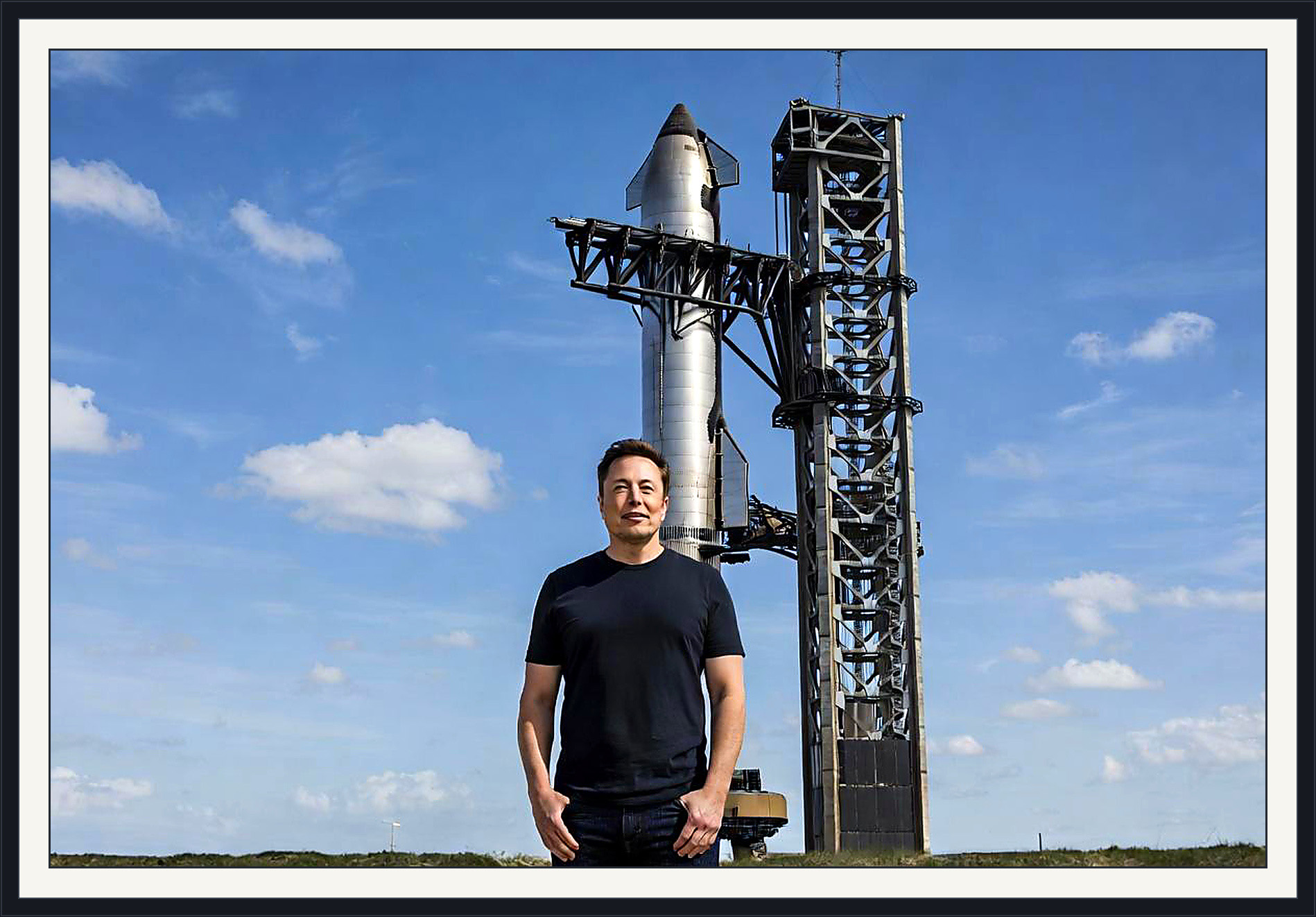
Two early technology exits. A revolution in electric vehicles. Reusable rockets. Commercial human spaceflight. A global satellite network. And a record-breaking public offering in 2026. The extraordinary sequence of business and engineering achievements that made Elon Musk one of the most consequential entrepreneurs of the modern era.
On September 28, 2008, a small rocket lifted off from a remote Pacific island.
It was called Falcon 1.
Three previous attempts to launch the rocket had failed. The company building it, SpaceX, was running dangerously short of money.
Its founder, Elon Musk, had invested much of the fortune he earned from selling his earlier technology businesses. He was simultaneously confronting a financial crisis at another company in which he had invested heavily: Tesla Motors.
Success was far from guaranteed.
But this time, Falcon 1 reached orbit.
The achievement made it the first privately developed liquid-fueled rocket to reach Earth orbit.
What followed was an extraordinary sequence of breakthroughs that would reshape entire industries.
Nearly eighteen years later, in June 2026, SpaceX completed a historic initial public offering, raising approximately $85.7 billion according to its official announcement.
The company that had once struggled to launch a small experimental rocket had become one of the world’s most valuable publicly traded businesses.
Between those two moments, Musk helped build an interconnected collection of enterprises spanning electric vehicles, energy storage, orbital transportation, satellite communications, artificial intelligence, and digital infrastructure.
Not every venture succeeded. Not every prediction materialized. Several of his businesses experienced serious setbacks, and his management decisions attracted considerable criticism.
But the documented sequence of technological and commercial achievements is extraordinary.
For Winning Streak, Elon Musk presents a compelling question: How does one entrepreneur repeatedly help bring entirely new businesses from improbable beginnings into large, established markets?
The answer begins long before rockets and electric cars.
Winning Streak No. 1: Zip2 — The First Business Exit, 1999
Elon Musk was born in Pretoria, South Africa, on June 28, 1971.
After moving to North America, he studied in Canada before continuing his education at the University of Pennsylvania, where he earned degrees in physics and economics.
In 1995, as the commercial internet was expanding rapidly, Musk and his brother Kimbal helped establish Zip2.
The company developed online business directories, mapping information, and publishing software for newspapers.
At the time, traditional media companies were searching for ways to bring their advertising and information services onto the internet.
Zip2 provided some of the tools required to make that transition.
The company attracted investment and established relationships with major newspaper publishers.
In 1999, Compaq Computer Corporation acquired Zip2 for approximately $307 million.
Musk received a substantial personal payout from the sale.
The significance was greater than the money alone.
He had participated in building a technology company around an emerging market, attracted investment, developed a commercial product, and helped deliver a successful acquisition.
Winning Streak Achievement No. 1: A successful technology company exit at age 27.
For many entrepreneurs, selling a company for hundreds of millions of dollars would represent the culmination of a career.
For Musk, it became capital for the next venture.
Winning Streak No. 2: X.com and PayPal — A Second Exit, 2002
In March 1999, Musk co-founded X.com, an internet-based financial services company.
His ambition was to use the emerging internet to transform banking and payments.
The concept was ambitious for its time.
Traditional financial institutions dominated consumer banking, while electronic commerce was still developing.
Online payments were often inconvenient, fragmented, and unfamiliar to consumers.
In 2000, X.com merged with Confinity, a company co-founded by Peter Thiel, Max Levchin, and others.
Confinity had developed a digital payment service called PayPal.
The merged company’s leadership went through significant disagreements and changes, including Musk’s removal as chief executive.
Nevertheless, Musk retained an important ownership position.
The business eventually adopted the PayPal name and expanded rapidly.
In October 2002, eBay acquired PayPal for approximately $1.5 billion in stock.
Musk, one of its largest shareholders, received approximately $165 million from the transaction.
It was his second major technology exit in less than four years.
More importantly, PayPal helped demonstrate the commercial possibilities of internet-native financial infrastructure.
The business was part of a broader transformation in which digital payments became increasingly central to electronic commerce.
Winning Streak Achievement No. 2: Two successful internet-era technology exits by age 31.
Musk had accumulated substantial capital.
He now began investing in industries whose products required far more than software.
Winning Streak No. 3: SpaceX — From Three Failures to Orbit, 2008
In 2002, Musk founded Space Exploration Technologies Corporation, better known as SpaceX.
His objective was to reduce the cost of launching payloads into space.
The traditional aerospace industry was dominated by government programs and established contractors.
SpaceX proposed an alternative: developing rockets and spacecraft commercially, with a particular emphasis on manufacturing efficiency and eventually reusing launch hardware.
The first major test was Falcon 1.
Its initial flight in March 2006 failed.
A second attempt in March 2007 also failed.
The third launch, in August 2008, ended unsuccessfully.
Each failure consumed time, capital, and confidence.
SpaceX had limited financial resources remaining.
Then came the fourth attempt.
On September 28, 2008, Falcon 1 successfully reached orbit.
The engineering breakthrough demonstrated that a privately financed company could develop and launch a liquid-fueled orbital rocket.
In December 2008, NASA awarded SpaceX a $1.6 billion contract for twelve cargo-resupply missions to the International Space Station.
The contract gave the emerging company an important commercial foundation.
SpaceX was no longer simply an ambitious aerospace startup.
It had demonstrated orbital capability and secured a significant customer.
Winning Streak Achievement No. 3: A historic orbital launch followed by a major NASA contract.
The company had survived a critical period.
Its next challenge was turning an individual achievement into a repeatable transportation service.
Winning Streak No. 4: Tesla — Bringing Electric Vehicles Into the Mainstream
While SpaceX was fighting for survival, Musk was helping guide another ambitious enterprise.
Tesla Motors had been established in 2003, with Martin Eberhard and Marc Tarpenning playing central founding roles.
Musk joined as a major investor and chairman in 2004, subsequently becoming chief executive officer in October 2008.
Tesla’s early objective was to prove that battery-electric vehicles could compete with conventional automobiles on performance, desirability, and practicality.
The original Tesla Roadster began reaching customers in 2008.
Its relatively high price limited its market, but it demonstrated that electric vehicles could be fast, attractive, and commercially desirable.
The next major milestone came in 2012 with the Model S.
Unlike the Roadster, the Model S was designed as a practical luxury sedan.
It helped challenge perceptions that electric vehicles were primarily small, slow, or limited-purpose machines.
In 2017, Tesla began production of the Model 3, intended to bring its technology to a wider market.
The transition was difficult.
Tesla encountered major manufacturing bottlenecks, financial pressures, and operational challenges.
Musk’s public descriptions of ambitious production targets often exceeded the company’s actual early output.
Nevertheless, Tesla eventually established large-scale electric vehicle manufacturing operations.
The company also expanded its battery and energy-storage businesses.
By 2020, Tesla recorded its first full calendar year of net profitability.
That accomplishment represented an important transition from a capital-intensive emerging automaker to a business capable of reporting sustained annual profits.
The broader automotive industry responded to growing demand for electric vehicles with substantial investments of its own.
Tesla was not alone in developing the market, nor did it invent the electric automobile.
Its achievement was helping accelerate the commercialization and international adoption of modern battery-electric vehicles.
Winning Streak Achievement No. 4: An electric vehicle business that progressed from a niche sports car to mass production and annual profitability.
The experiment had become an industrial enterprise.
Winning Streak No. 5: SpaceX Learns to Land Rockets — 2015 to 2017
For decades, conventional orbital rockets were largely expendable.
Their expensive first stages were generally discarded after launch, making each mission dependent on the manufacture of substantial new hardware.
SpaceX pursued a different model.
What if a rocket booster could return to Earth, land safely, and fly again?
The concept was deceptively simple.
Executing it required extraordinary advances in propulsion control, guidance, structural design, and flight software.
On December 21, 2015, SpaceX achieved the first successful landing of a Falcon 9 orbital-class first stage after a mission to space.
The booster returned vertically to Landing Zone 1 at Cape Canaveral.
On April 8, 2016, SpaceX achieved another major milestone when a Falcon 9 booster landed on an autonomous droneship at sea.
Then, on March 30, 2017, the company successfully launched a previously flown Falcon 9 first stage for a second orbital mission.
The sequence changed the economics and operational possibilities of space transportation.
Instead of treating rockets entirely as disposable equipment, SpaceX began developing an operational system around the recovery, refurbishment, and reuse of major launch components.
The company was not the first to reuse any type of rocket; reusable suborbital vehicles had preceded it.
Its distinction was demonstrating the recovery and operational reflight of orbital-class boosters.
Winning Streak Achievement No. 5: Three landmark achievements in reusable orbital rocketry in less than sixteen months.
The result was more than an engineering demonstration.
It created a foundation for increasingly frequent launches.
Winning Streak No. 6: Taking Astronauts Back Into Orbit — 2020
On May 30, 2020, a Falcon 9 rocket lifted off from NASA’s Kennedy Space Center in Florida.
Aboard the Crew Dragon spacecraft were NASA astronauts Robert Behnken and Douglas Hurley.
The mission, known as Demo-2, marked the first launch of astronauts from American soil aboard an American spacecraft since the retirement of the Space Shuttle in 2011.
It was also the first crewed orbital launch using a commercially built and operated spacecraft.
The mission followed earlier SpaceX milestones, including Dragon becoming the first privately developed spacecraft to reach the International Space Station in 2012.
After docking with the station and completing their mission, the astronauts safely returned to Earth in August 2020.
The achievement represented a major development in commercial spaceflight.
NASA had helped make it possible through long-term investment, contracts, technical oversight, and its Commercial Crew Program.
SpaceX had supplied the transportation system and demonstrated that a private company could operate a spacecraft carrying astronauts into orbit.
It was another significant step in the evolution of commercial aerospace.
Winning Streak Achievement No. 6: The transition from privately developed orbital rockets to carrying astronauts safely into orbit and back.
A business that began by struggling to launch small rockets had become a human-spaceflight operator.
The Measurable Streak: 96, 134, 165
Historical breakthroughs explain SpaceX’s reputation.
But an equally important measure of sustained business execution is the ability to repeat operations at scale.
According to SpaceX’s securities disclosures, its Falcon launch activity increased across three consecutive calendar years:
- 2023: 96 launches.
- 2024: 134 launches.
- 2025: 165 launches.
The increase demonstrates how rocket reusability, operational experience, manufacturing capacity, and growing demand supported a much higher launch cadence.
Not all these launches carried paying external customers. Many deployed satellites for SpaceX’s own Starlink network.
That distinction matters commercially.
The launch system was becoming both a service for third parties and infrastructure supporting the company’s satellite business.
By the first nine months of 2026, SpaceX reported 110 Falcon launches, compared with 124 during the equivalent period of 2025.
The earlier annual growth should therefore not be mistaken for a guarantee of uninterrupted acceleration.
Nevertheless, the 2023–2025 sequence represents a clearly documented operational winning streak.
Three consecutive years of rising Falcon launch totals.
Unlike valuations or predictions, these were completed operations that could be counted and independently examined.
Winning Streak No. 7: Starlink — From Rocket Launches to Global Connectivity
The next major business development was Starlink.
SpaceX had developed increasingly capable rockets and an infrastructure for frequent launches.
Starlink gave that infrastructure a new commercial purpose: providing communications services through a constellation of satellites in low Earth orbit.
Instead of relying exclusively on terrestrial cables and communications towers, Starlink could connect customers through satellites and ground-based terminals.
The service expanded into residential broadband, enterprise connectivity, maritime communications, aviation, and government applications.
The commercial growth was substantial.
According to SpaceX’s third-quarter 2026 financial disclosures, Starlink reached approximately 13.6 million consumer subscriptions at September 30, 2026, compared with 7.2 million one year earlier.
The company’s definition counts individual service lines rather than unique human users.
The growth was accompanied by lower average consumer revenue per subscription, reflecting expansion into different markets and lower-priced service offerings.
For the first nine months of 2026, SpaceX reported approximately $12.8 billion in connectivity segment revenue.
The larger historical significance is that SpaceX had developed two complementary businesses.
One launched satellites.
The other used those satellites to sell communications services.
Each could support the other’s expansion.
Winning Streak Achievement No. 7: The development of a global satellite connectivity business supported by the company’s reusable launch infrastructure.
The rocket company had become a communications infrastructure company as well.
Winning Streak No. 8: Starship and a New Engineering Frontier — 2024
Even as Falcon 9 matured into a commercially established launch system, SpaceX pursued a much larger spacecraft.
Starship was designed to advance the development of a fully reusable space transportation system with substantially greater payload capacity.
The development process included failures, explosions, redesigned components, and difficult engineering tests.
On October 13, 2024, SpaceX conducted Starship’s fifth integrated flight test.
After liftoff and stage separation, the enormous Super Heavy booster returned toward the launch site in Texas.
Rather than landing on conventional legs, it approached a specially designed launch tower.
Two large mechanical arms closed around the booster and secured it.
The achievement was visually astonishing.
A giant rocket stage had returned from flight and been caught by its launch infrastructure.
It was an experimental milestone, not proof that the entire Starship system was already operational or fully reusable.
Nevertheless, it demonstrated progress toward an exceptionally ambitious engineering goal.
Winning Streak Achievement No. 8: The successful tower catch of a Super Heavy booster during Starship’s fifth flight test.
The next phase of development remained uncertain, with further testing and substantial investment required.
The 2026 Milestone: SpaceX Becomes a Public Company
On June 12, 2026, SpaceX shares began trading on Nasdaq under the symbol SPCX.
The offering was historically significant.
After the underwriters exercised their option to purchase additional shares, SpaceX announced that its initial public offering had generated approximately $85.7 billion in proceeds.
The offering followed more than two decades of development, from Falcon 1 to reusable orbital launch systems and global satellite infrastructure.
For investors, the publicly traded company also represented something considerably broader than the original aerospace startup.
In February 2026, SpaceX had combined with Musk’s artificial intelligence business, xAI.
Its corporate structure therefore brought together space transportation, connectivity, digital platforms, and artificial intelligence infrastructure.
The expansion introduced new opportunities as well as important risks.
SpaceX’s financial disclosures reflected the enormous capital demands of its growth strategy, particularly investments in artificial intelligence infrastructure and Starship development.
The value assigned by public markets did not eliminate questions about future profitability, competition, regulation, or the economic returns on such substantial investments.
Still, the contrast with 2008 was striking.
A company that once faced repeated launch failures had survived, expanded into major operating businesses, and completed a record-breaking public offering.
Winning Streak Achievement No. 9: The June 2026 SpaceX IPO, a historic capital-markets milestone for commercial space enterprise.
It was not the end of the story.
It marked the beginning of a new era of public-market accountability.
The Businesses That Have Yet to Prove Themselves
An accurate account of Musk’s career must distinguish completed accomplishments from future ambitions.
Tesla’s vehicle deliveries declined in both 2024 and 2025, as competition intensified and the electric vehicle market evolved.
The company delivered approximately 1.64 million vehicles in 2025, while deploying a record 46.7 gigawatt-hours of energy-storage products.
During the third quarter of 2026, Tesla delivered 486,532 vehicles, but its profitability remained under pressure.
Other Musk-associated ventures, including Neuralink and The Boring Company, pursued technologies that were still developing commercially or undergoing extensive technical and regulatory evaluation.
The acquisition and transformation of Twitter into X also produced substantial controversy, with continuing debate over platform governance, advertiser relationships, financing, and business performance.
Artificial intelligence opened another field of competition, with rapidly growing technological opportunities accompanied by substantial financial, operational, and governance risks.
Even the possibility of combining Tesla and SpaceX remained unresolved.
In October 2026, the two companies formed special committees to evaluate a potential combination. As of October 28, no completed merger had been announced.
The historical record therefore does not support describing Musk as an entrepreneur who never loses.
It supports a more interesting conclusion.
He has repeatedly participated in building ambitious companies that achieved important technological or commercial milestones, while also experiencing failures, delays, financial pressures, and controversial decisions.
The Business Strategy Behind the Winning Streak
What explains the unusual sequence of achievements?
Several recurring characteristics emerge from the historical record.
Entering Markets Undergoing Structural Change
Zip2 emerged during the internet’s expansion into publishing.
PayPal developed during the growth of electronic commerce.
Tesla expanded as battery technology, manufacturing methods, and consumer interest made modern electric vehicles increasingly practical.
SpaceX developed amid efforts to increase commercial participation in space transportation.
Starlink took advantage of advances in satellite manufacturing, communications technology, and low-cost orbital launch capacity.
The common feature was the identification of markets undergoing significant technological change.
Investing in Infrastructure Rather Than Products Alone
Several of Musk’s businesses invested in the systems necessary to deliver their products repeatedly.
Tesla developed manufacturing facilities, battery supply chains, and charging infrastructure.
SpaceX built rockets, spacecraft, launch facilities, and satellite manufacturing capabilities.
Starlink depended upon a combination of spacecraft, terminals, communications systems, and global operations.
This approach required substantial capital and created significant execution risks.
But where it succeeded, it gave the companies greater control over essential parts of their operations.
Reusing Capabilities Across Businesses
The relationship between Falcon 9 and Starlink demonstrates the strategic value of complementary infrastructure.
More affordable, frequent launches made satellite deployment easier.
Satellite operations created continuing demand for rocket launches.
Similarly, Tesla’s experience with batteries, power electronics, and energy management supported the expansion of its energy-storage business.
This pattern helped connect new ventures to capabilities already developed elsewhere.
Repeated Experimentation
The development of Falcon 1, Falcon 9 recovery systems, and Starship required testing and redesign.
Individual failures did not automatically terminate the programs.
Instead, engineers used results from unsuccessful attempts to improve subsequent versions.
This does not mean every failure was necessary or that aggressive development methods always produced the best outcome.
It does demonstrate the importance of organizations capable of learning and adapting quickly.
Teams, Capital, and Institutional Partnerships
No account of these achievements is complete without recognizing the contributions of thousands of other people.
Tesla’s development depended upon its original founders, engineers, manufacturing specialists, investors, and employees.
SpaceX’s success depended upon executives including Gwynne Shotwell, large engineering teams, launch personnel, suppliers, NASA partnerships, and substantial financial resources.
Government contracts and public-sector investment were especially important in commercial spaceflight.
The achievements associated with Musk’s leadership were collective accomplishments, not feats performed by one person acting alone.
Recognizing that reality makes the history more accurate and the achievements more impressive.
The Winning Streak Legacy
What makes Elon Musk a compelling inaugural subject for Winning Streak’s Business & Markets collection is not simply his wealth or public recognition.
It is the historical sequence.
In 1999, Zip2 was acquired.
In 2002, PayPal was acquired.
In 2008, Falcon 1 reached orbit.
In 2012, Dragon reached the International Space Station.
In 2015, Falcon 9 landed an orbital-class booster.
In 2017, SpaceX successfully flew a previously used orbital-class booster again.
In 2020, Crew Dragon carried NASA astronauts to orbit.
In 2024, Starship’s Super Heavy booster was caught by its launch tower.
In 2026, SpaceX completed a record-breaking public offering.
Each milestone marked a separate achievement, not an uninterrupted chain of business victories.
But together they represent an unusual sequence of technological and commercial progress spanning more than a quarter-century.
The most important historical distinction is that an entrepreneur’s winning streak need not mean success in every undertaking.
Markets change. Technologies fail. Companies experience setbacks. And future ambitions remain unproven until they are achieved.
What matters is the repeated ability to turn difficult ideas into completed accomplishments.
For Elon Musk, those accomplishments have included two major early technology exits, the industrial expansion of electric vehicles, reusable orbital rockets, commercial human spaceflight, global satellite communications, and a historic capital-markets transaction.
In 2008, a small rocket barely reached orbit after three failed attempts.
In 2026, the company that built it was operating an international space and communications business with millions of customers.
Elon Musk (born 1971). Two early technology exits. A sequence of aerospace breakthroughs. Three consecutive years of rising Falcon launch totals from 2023 through 2025. One extraordinary, still-unfinished chapter in business history.
His story offers a defining lesson for the Winning Streak archive:
A remarkable winning streak is not the absence of failure. It is the repeated conversion of uncertainty into achievement.
Winning Streak chronicles remarkable consecutive achievements, investigating the history, individuals, decisions, and circumstances that made them possible.
Historical Research & References
- Tesla Investor Relations — Elon Musk Biography — Early business ventures, corporate positions, and leadership chronology.
- NASA — SpaceX Historical Milestones — Falcon 1, NASA contracts, and early commercial spaceflight.
- SpaceX — Company Milestones — Rocket recovery, orbital reflight, and Dragon achievements.
- NASA — Historic Demo-2 Launch, May 30, 2020
- SpaceX — Starship’s Fifth Flight Test — October 13, 2024 booster recovery.
- Tesla Investor Relations — 2025 Production, Deliveries and Deployments
- Tesla Investor Relations — Q3 2026 Deliveries
- SpaceX — June 2026 IPO Announcement
- SEC — SpaceX Third Quarter 2026 Form 10-Q
- SEC — Tesla 2025 Annual Report